
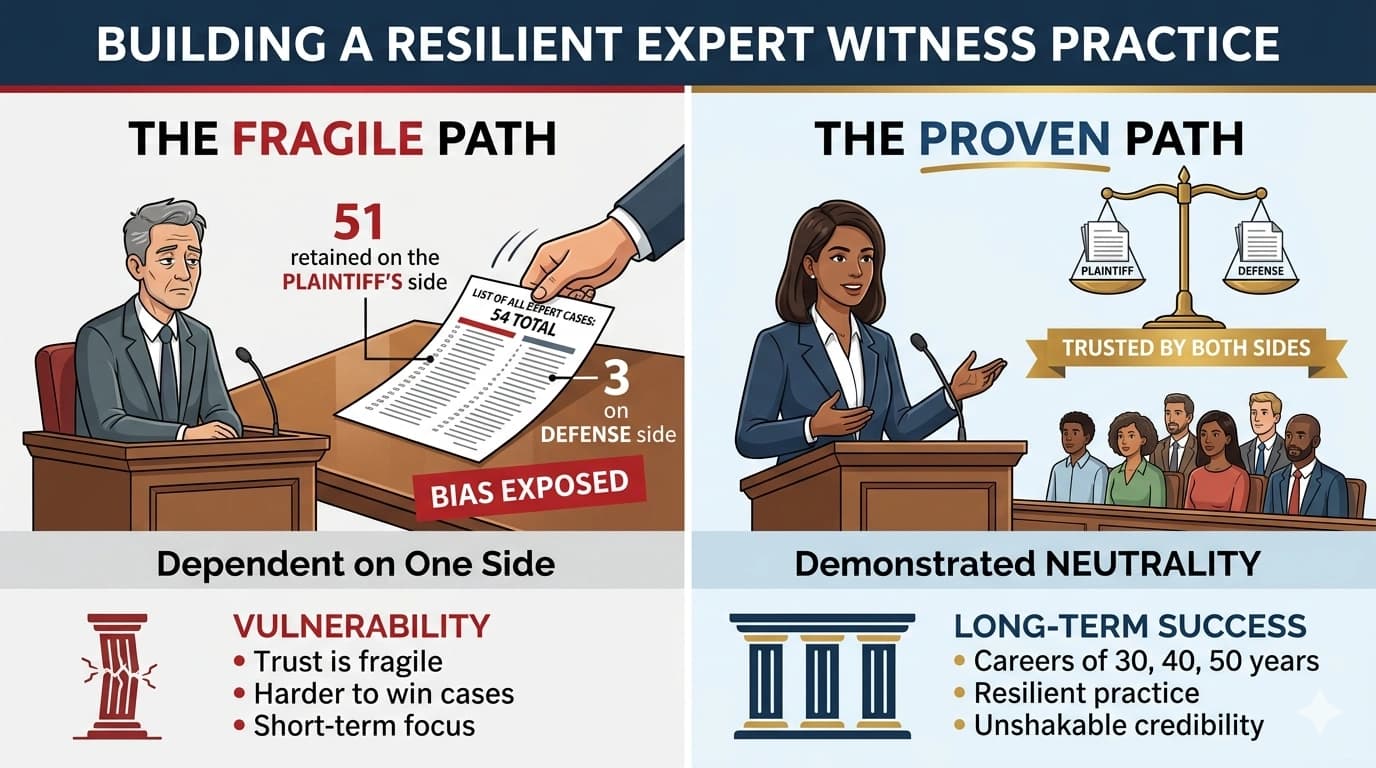
Picture the moment. You are sitting in a deposition chair. Opposing counsel is holding a document — a printout, spreadsheet-formatted, two pages long. It is a list of every case you have ever worked as an expert witness. All 54 of them. The attorney slides it across the table slowly, the way people do when they already know the answer to the question they are about to ask.
“Can you confirm,” she says, “that of these 54 cases, 51 were retained on the plaintiff’s side?”
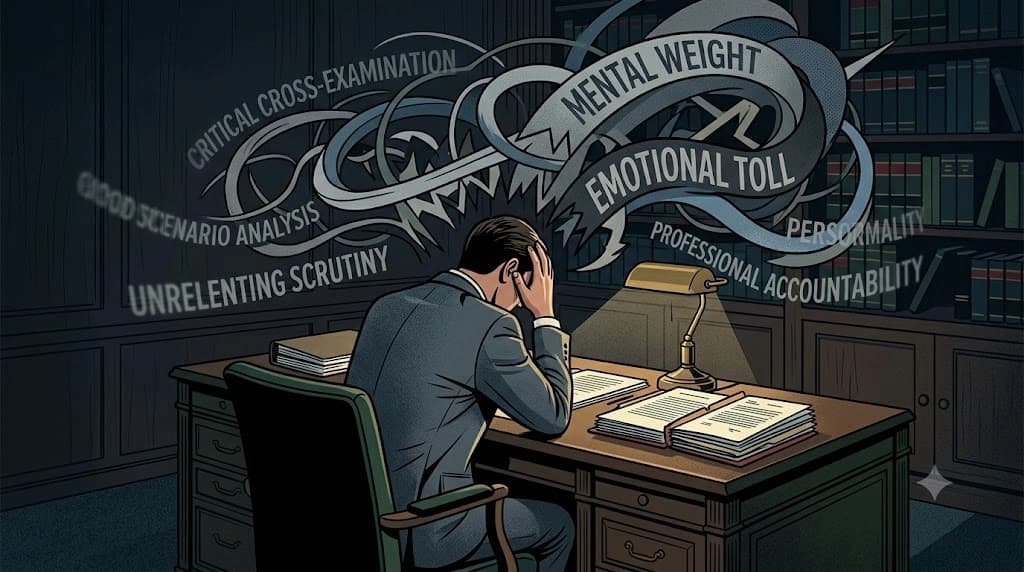
You can feel the jury watching. You can see your retaining attorney’s pen stop moving.
You don’t need to lose the case in that moment. But you have just made it significantly harder to win. And the uncomfortable truth is: you saw this coming. Everyone does, eventually. The only question is whether you do something about it before that spreadsheet appears — or after.
The Problem Has a Name
In the expert witness community, it is called being a “hired gun” — an expert so reliably aligned with one side of the litigation divide that their testimony has become, for all practical purposes, a product for sale. The term is dismissive, sometimes unfair, and yet it sticks because it captures something real about how credibility gets eroded in courtrooms every day.
What makes the hired gun label so dangerous is not that it is always accurate. It is that it is almost impossible to disprove once it attaches. An expert with a 90/10 plaintiff–defense split can argue that the imbalance reflects the structure of their field, the nature of referrals, or the cases that happened to come their way. All of that may be true. But opposing counsel is not making a factual claim when they brandish that spreadsheet. They are making a psychological one. They are inviting the jury to decide whether this person sitting in front of them is a truth-teller or a very expensive advocate.
Juries, it turns out, are quite good at making that determination. They have been watching people try to persuade them their whole lives.
“Credibility is the Alpha and the Zeta. It is the beginning and the end of everything I think about when I am evaluating an expert for a case.”
— Jordan Redavid
Plaintiff Trial Attorney · On The Stand, Season 1, Episode 2
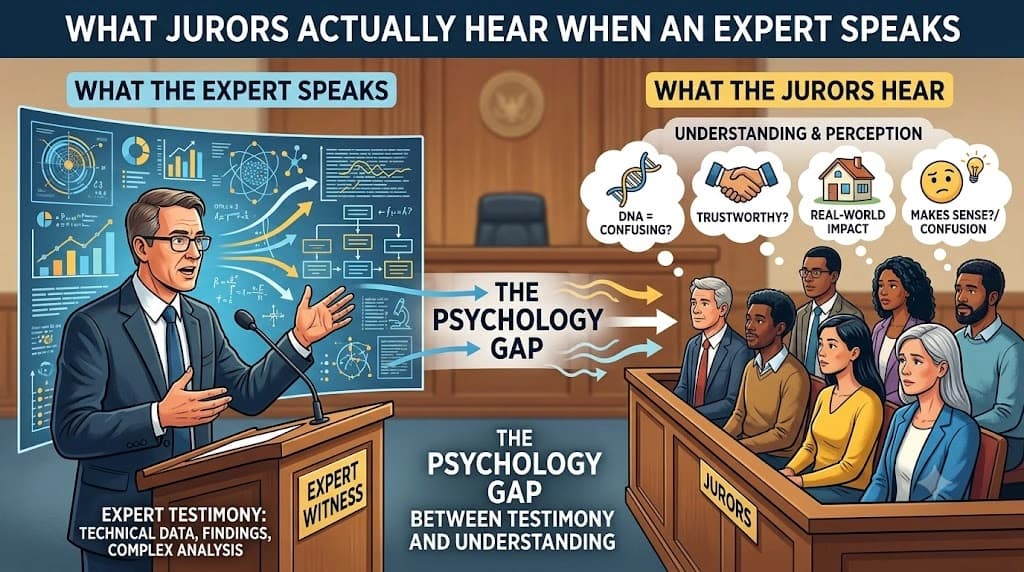
Jordan Redavid, a plaintiff trial attorney featured in Season 1, Episode 2 of On The Stand, has tried enough complex cases to know what he is looking for when he vets an expert. It is not the CV. It is not the publications list. Those things earn a phone call. What earns a case is something harder to measure and harder to fake: the sense that this person will walk into a courtroom, sit in that chair, swear to tell the truth, and actually tell it — in a way a room full of ordinary people can understand and trust.
“I don’t care how long their resume is,” Redavid says. “If they can’t do that, they are useless to me.”
The Question Every Attorney Asks — And What Your Answer Reveals
There is a question that gets asked in almost every initial conversation between an attorney and a prospective expert. Sometimes it is asked directly. Sometimes it surfaces in the intake form. Sometimes it comes up obliquely, disguised as casual conversation.
The question is: what percentage of your cases are plaintiff versus defense?
George Reis, a forensic imaging and video analysis expert who built his practice from the ground up and was featured in Season 2, Episode 1, knows this question is coming every time. He also knows that how he answers it is not just a data point — it is a signal. A balanced caseload tells the attorney that this expert has been trusted by both sides of the adversarial divide. That plaintiff attorneys have hired them and been satisfied. That defense attorneys have hired them and been satisfied.
“If you develop good relationships with your clients, always deliver more than they expect, keep communications open,” Reis says (Season 2, Episode 1), “they’ll remember you and want to come back.” The attorneys who come back — on both sides — are the ones who found that the expert’s work held up under cross-examination, in front of a skeptical jury.
Dr. Stephen Cohen, a board-certified colorectal surgeon and guest on Season 3, Episode 1, describes his relationship with the plaintiff–defense question in a way that stops many people short. He says that sometimes, when he delivers his opinion, he genuinely cannot remember which side retained him. The analysis was the analysis. The standard of care was the standard of care. The facts either support the hypothesis or they do not.
That is not a performance of objectivity. It is what objectivity actually looks like when it has been practised for thirty years.
“The second you have a bias, your credibility is gone forever.”
— Dwayne King
Anti-Money Laundering Expert · On The Stand, Season 3, Episode 9
Dwayne King, an anti-money laundering expert and Season 3, Episode 9 guest, spent decades in law enforcement before transitioning to expert witness work in financial crime. He arrived in the profession with an acute awareness of a trap that catches many experts from prosecution-side backgrounds: the instinct to frame every case through the lens of the side you used to serve.
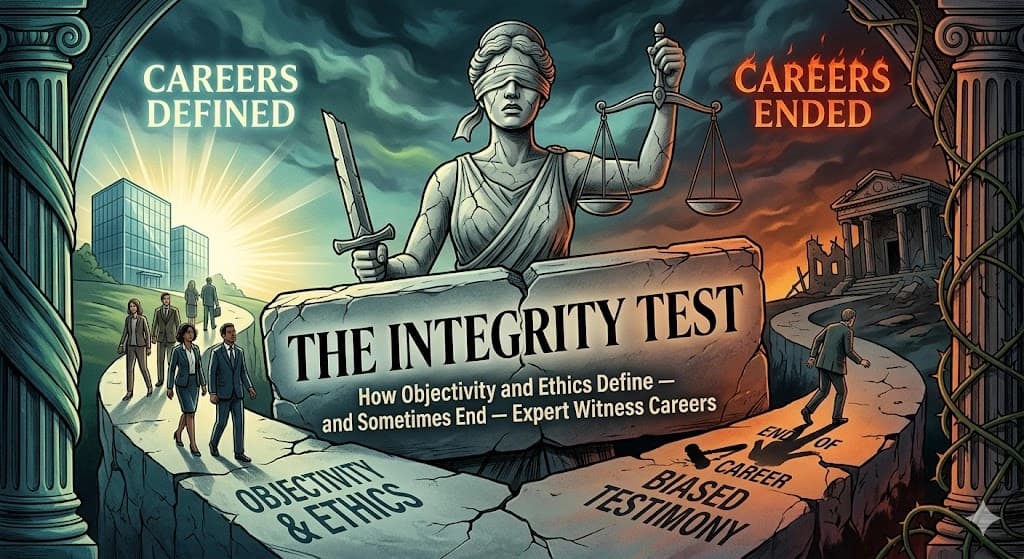
“You cannot be seen as biased,” he says. “The second you have a bias, your credibility is gone forever. Your opinion can’t be biased, you can’t be biased, you can’t have a hint of bias.” His words carry the weight of someone who has watched careers end not in dramatic courtroom moments but in quiet, gradual erosion — case by case, as attorneys began to whisper to each other about the expert whose conclusions were, somehow, always the same no matter what the facts were.
The 50/50 Standard — What It Is and What It Isn’t
Let us be precise about something, because there is a version of this argument that gets badly misread.
The goal is not a perfectly even case split. A forensic accountant who works primarily on fraud cases may find that the nature of their referral network tilts heavily toward plaintiffs — because fraud victims are the ones suing. These patterns are real, and a rigid insistence on numerical parity would produce absurd results.
The goal is something subtler: the discipline to ask, honestly, whether your caseload balance reflects the structure of your field — or the gradual accumulation of choices that made one side more comfortable than the other.
James E. Lewis, a transportation safety expert featured in Season 2, Episode 6, wrote an article with the direct and unsentimental title: “Does an Expert Witness Have a Shelf Life?” One of the fastest ways to expire, he argues, is to become so identified with one side of the aisle that the other side stops calling. Lewis made a deliberate choice: he started driving to Las Vegas to teach CLE sessions at defense firms — investing in relationships with attorneys who had never seen him work, so they could experience his methodology firsthand.
“An expert’s only asset is credibility and integrity. Once compromised, these things are essentially unrecoverable.”
— Robert Handfield
Supply Chain Management Expert · On The Stand, Season 2, Episode 10
Robert Handfield, a supply chain management expert and Season 2, Episode 10 guest, has testified in cases generating verdicts in the tens of millions of dollars and was consulted by the White House on supply chain policy. None of that, he will tell you, is the thing that actually matters most. What matters most is a sentence he returns to again and again: an expert’s only asset is credibility and integrity.
“If you said this on the front page of the New York Times, would you feel comfortable?” That is Handfield’s internal test before every opinion he gives. If the answer is yes, proceed. If not — if there is any version of the analysis you would not want to defend in that forum — the analysis is not ready.
The Objectivity Discipline: What It Demands Day to Day
Maintaining objectivity sounds easy in theory. Most experts, when asked, will say they are objective. The problem is that objectivity is not a trait. It is a practice. And like any practice, it requires deliberate effort, honest self-examination, and the willingness to make uncomfortable choices.
Handfield’s practice starts before a case begins. When approached about a potential engagement, he reviews the hypothesis he is being asked to address. Does this question, honestly assessed, align with what the facts support? If accepting the case would require him to justify a position he does not actually hold, he declines.
This is harder than it sounds. High-value cases from well-established law firms carry a financial gravity that pulls at everyone in this profession. The temptation to accept and then find the analysis, rather than finding the analysis and then accepting, is real and persistent.
Alvin Wolff, a personal injury attorney with over 7,000 cases across more than four decades of practice, featured in Season 2, Episode 5, has seen more expert witnesses perform under pressure than almost anyone alive. When he talks about what separates the experts who help him win from the ones who do not, he returns to the same qualities: straightforwardness, accessible language, and the particular kind of confidence that comes not from bravado but from having nothing to hide.
“The jury knows,” he says. “They may not be able to articulate what they are seeing, but they know the difference between someone telling the truth and someone performing the truth.” After 7,000 cases, that carries weight.
What This Means For You
Whether you are an expert building your practice or an attorney evaluating one, the credibility test is the same:
• If you are an expert: your case balance is visible, trackable, and will be used against you if it is lopsided. Address it deliberately, not reactively.
• If you are an attorney: the question “what is your plaintiff–defense split?” is not small talk. It is the single fastest signal of whether your expert will survive a credibility challenge.
• For both: the long game always wins. Credibility built over decades of honest, balanced work is the only professional asset in this field that compounds.
The Business Case: Why Integrity Is Also Good Economics
There is a version of this conversation that frames objectivity as a sacrifice — something noble experts do at the cost of their commercial interests. That framing is not just wrong. It is backwards.
A genuinely balanced caseload means your work has been vetted by attorneys on both sides of the adversarial divide. When a plaintiff attorney calls you, they know defense attorneys have trusted you — and vice versa. Your reputation is not tied to the fortunes of one side of the market.
Kevin Quinley, an insurance and claims expert and the very first guest on Season 1, Episode 1 of On The Stand, identifies the visibility paradox that traps many experts early: you need cases to prove your value, but attorneys won’t hire you without proof of value. The exit from this paradox is not to take whatever comes — it is to position yourself deliberately, from the beginning, as an expert whose work is available to both sides.
Reis built his forensic imaging business from zero in 2004. He followed up with every client. He approached each engagement as an audition — not just for the next case with the same attorney, but for the referral that attorney would make to a colleague six months later. Twenty years on, he does not advertise at all. Nearly all of his work comes through word of mouth and referrals from other analysts.
The word of mouth that sustains a practice like his is not built on winning. It is built on being right. The attorneys who keep calling Reis — plaintiff and defense alike — are the ones who found that his analysis held up when it needed to. That his testimony was consistent. That he did not say different things to different clients about the same set of facts. That is not charity. That is the most reliable business development strategy in a profession built on trust.
What You Can Actually Do About It
If you are reading this and feeling some recognition — if the spreadsheet scenario at the opening of this piece felt less hypothetical than you would like — here is the practical reality: the imbalance is fixable, but it requires deliberate action. It does not fix itself.
The first step is an honest audit. Pull your case history. Calculate your actual plaintiff–defense split. If you find it significantly skewed in one direction, the question is not how to hide that fact — it will come out in deposition — but how to begin correcting it.
Lewis’s CLE approach is one model: teaching attorneys about your expertise puts your work in front of people on the side of the aisle you are underrepresented on. It is not fast. It is not guaranteed. But it creates relationships based on demonstrated competence rather than a listing service entry.
And when you are asked the question — what is your plaintiff–defense split? — answer it directly and without apology. Transparency is itself a credibility signal. It tells the attorney that you are not managing your image; you are managing your practice.
THE CREDIBILITY SELF-AUDIT
Six questions every expert witness should answer honestly — right now.
1 If opposing counsel printed your full case history today, what would the plaintiff–defense ratio show?
A split beyond 80/20 is visible to every attorney in the room.
2 Have you ever accepted a case because it paid well — before honestly assessing whether the facts supported the hypothesis?
Financial gravity is real. The best experts have systems to counteract it.
3 Can you name three attorneys on the side of the aisle you work with less frequently who would vouch for your work?
If not, that side of the market doesn’t know you exist.
4 When did you last decline a case because your honest opinion didn’t support what the retaining attorney needed?
Declining the wrong case is one of the most powerful credibility signals you can send.
5 Would you be comfortable if your last three expert reports were published on the front page of a major newspaper?
Robert Handfield’s test (S02E10). It should feel like the answer is obviously yes.
6 If a jury were told your plaintiff–defense split right now, would they see it as evidence of expertise — or evidence of a point of view?
That is the question opposing counsel is waiting to ask.
The attorneys who keep getting called back have one thing in common. It is not their credentials. It is that the attorneys who hired them were never embarrassed by the experience.
That is the standard. Not perfection. Not a mandatory 50/50 split. The standard is that when an attorney puts you in front of a jury, they are confident — because you have given them every reason to be — that you will tell the truth, hold up under challenge, and that your analysis will be exactly what you said it was from the first call.
The lawyers who keep calling the same experts, case after case, decade after decade, are not doing it because those experts always find what they hoped to find. They are doing it because those experts find what is actually there — and that, over time, is worth more than any credential on the wall.
About This Series
This article is part of a series developed from On The Stand with Ashish Arun, drawing on insights from 31 expert witnesses, trial attorneys, and evidence law scholars across three seasons of the podcast. Each article synthesises perspectives from five or more guests to provide analysis no single interview could deliver alone.
Experts featured: George Reis — Forensic Imaging Expert (S2E01) · Jordan Redavid — Plaintiff Trial Attorney (S01E02) · James E. Lewis — Transportation Safety Expert (S02E06) · Robert Handfield — Supply Chain Expert (S02E10) · Alvin Wolff — Personal Injury Attorney (S02E05) · Kevin Quinley — Insurance & Claims Expert (S01E01) · Dr. Stephen Cohen — Colorectal Surgeon (S03EP1) · Dwayne King — Anti-Money Laundering Expert (S03EP9)