
The Fundamental Paradox - Being Paid for Your Opinion Without Being Bought
The structural tension in expert witness work is not subtle. An expert is retained by one party, paid by one party, and expected by that party to advance a favourable theory of the case. Yet the legal system - and more importantly, the expert's own long-term professional standing - requires that they behave as though they were retained by neither side. This tension does not resolve itself. It must be actively managed, case by case, through a set of professional disciplines that the most respected practitioners have internalized so deeply that they no longer experience them as constraints.
The clearest articulation of how this tension is resolved comes from a practitioner who has spent more than five decades at the intersection of corporate governance, securities law, and complex business litigation. Richard Leisner, a corporate and securities law expert with over fifty years of experience who appeared on Season 2, Episode 11 of On The Stand, returns to a single principle whenever the question of professional loyalty arises. The Society of Expert Reporters seal, he explains, carries a specific instruction that he has adopted as the governing rule of his practice: "seek and speak the truth." "That your only client as an expert is the truth or your opinions," Leisner says. "You're not a defense witness. You may be called by the defense, but you're not a defender." That distinction - between being retained by the defense and being a defender - is the intellectual frame that holds an integrity-first expert practice together.
The consequence of failing this standard is not merely reputational. It is practical. Once the credibility that makes an expert's opinion legally valuable is compromised, it is essentially unrecoverable. No volume of subsequent work can fully restore what has been lost. This is a market mechanism as much as a moral one - the legal system's long memory for experts whose opinions followed their fees is among the most effective accountability structures the profession has.
The First Gate - Refusing the Wrong Cases
Before an integrity failure can occur in testimony, it typically has an opportunity to occur at the moment of case selection. The experts who maintain clean track records over long careers are almost uniformly disciplined about which cases they accept - and how they communicate the limits of their expertise to the attorneys who approach them.
One of the clearest articulations of this principle comes from an expert who built his practice in the unglamorous but litigation-rich world of occupational health and chemical exposures. Jonathan Klane, a certified industrial hygienist with thirty-five years of experience in environmental health and safety who appeared on Season 3, Episode 11 of On The Stand, has a practice he recommends to every expert entering the field: have the scope conversation before the case begins. "I always have this conversation," he explains. "Here's where I think I can help. And here's where I want to tell you that I'm not this expert, I'm not that." Providing that clarity upfront - acknowledging the boundaries of expertise before a case is accepted - is not just an ethical obligation. It is also, Klane notes, one of the primary reasons that experts who do it consistently tend to have records free of Daubert exclusions. Most exclusions happen when experts step just outside their lane. The ones who are candid about where their lane ends rarely face that problem.
Klane goes further. He does not track whether the clients who retained him won or lost their cases. "I honestly have no idea how many cases I've been involved with where my client prevailed versus did not," he says. "I don't track it because I don't need to, I don't want to." This is not indifference to his work - it is a deliberate professional discipline. An expert who tracks their win rate is subtly measuring something they should not be measuring. The right measure is whether the opinion was honest and well-grounded. The outcome of the case belongs to the attorney. The integrity of the analysis belongs to the expert.
Leisner approaches case selection from a different angle: the practical discipline of saying no when there is insufficient time to do the work properly. Attorneys sometimes call at the end of a week with twenty-one depositions, four amended complaints, and a request for an expert report by Thursday. His response has become increasingly direct with experience: I cannot help you. "If you take on more than you can handle," he explains, "you probably are not going to be happy about the results." A rushed opinion carries its own integrity risks - not necessarily in the sense of dishonesty, but in the sense of inadequate record review and conclusions that cannot withstand the scrutiny opposing counsel will apply.
"Your Only Client Is the Truth" - Managing Bias in High-Stakes Fields
For experts who work in fields where the subject matter carries inherently high stakes - financial crime, securities fraud, patient safety - the integrity requirement is not merely professional. It is personal. The expert's background, their prior career, and the instincts built over decades can themselves become sources of bias that must be actively managed.
No practitioner in the On The Stand conversations articulates the stakes of bias more directly than one who built his expertise at the intersection of law enforcement and financial crime. Dwayne King, an anti-money laundering expert with over thirty-five years of combined experience in law enforcement and the financial sector who appeared on Season 3, Episode 9 of On The Stand, has a standard he applies without exception: "You cannot be seen as biased. The second you have a bias, your credibility is gone forever. Your opinion can't be biased, you can't be biased, you can't have a hint of bias." For King, this is not a rule adopted because it reads well in a professional bio. It is a discipline he has had to consciously cultivate, because his background as a law enforcement officer - two decades working financial crime investigations - creates a structural bias risk he must counteract in every case. When analyzing money laundering, his instincts from a career spent investigating criminals could easily predispose him to see guilt where an objective reading of the evidence might not support it. The integrity requirement forces him to separate what he knows from what he assumes.
A parallel discipline appears in how a finance and securities expert approaches the boundaries of permissible opinion. Pavithra Kumar, a principal at AACG and an expert in finance, securities, and damages estimation who appeared on Season 3, Episode 2 of On The Stand, identifies one of the most consistent patterns in opposing experts whose opinions are vulnerable to attack: scope creep. The tendency to make "overly aggressive assumptions" - to reach just beyond what the evidence and the expert's genuine expertise can support - is, she observes, the most common place where expert integrity fractures. "Not stepping outside of your particular scope," she explains, combined with "really thoroughly testing all of your assumptions and expressing in very simple language your main point" - these are the disciplines that protect an opinion from the kind of cross-examination that unravels credentialed advocates. The commitment to staying within scope is, in the context of expert integrity, an act of intellectual honesty: the acknowledgment that expertise has limits, and that those limits should govern what an expert is willing to say under oath.
When Integrity Is Tested - Cross-Examination, Pressure, and the Hired Gun Problem
The most visible integrity test an expert witness faces arrives in cross-examination. Opposing counsel's goal in those moments is to find the seam where an opinion began to bend - the place where stated reasoning diverges from the underlying analysis, or where what the expert says under oath differs from what they have said in prior proceedings. The experts most resistant to this kind of attack are those who have nothing to conceal, because their opinions were formed honestly in the first place.
King has testified in financial crime cases across Canada and has developed a clear philosophy about navigating these moments. When opposing counsel targets his law enforcement background - suggesting that two decades as a proceeds-of-crime investigator makes his financial analysis inherently skewed against defendants - his response is not defensiveness. It is transparency. "I have to be completely and absolutely unbiased. Whatever it takes." Judges observing these exchanges see what opposing counsel is working to obscure: an expert who is honest about their background and candid about how they have managed its implications carries more credibility, not less, than one who pretends the implications do not exist.
Klane has his own account of an integrity moment in the middle of cross-examination - one that illustrates how honesty in the smallest things compounds into credibility over time. During a mold case deposition, opposing counsel handed him a poorly formatted spreadsheet and asked him to identify a specific sample number. Klane could not read it clearly. Rather than guessing, he said so: he could not answer the question because what he had been handed was not legible. When counsel produced a legal pad to use as a straight edge, Klane found the correct sample, then offered the pad back when opposing counsel complained they no longer had one. The courtroom laughed. But the deeper point preceded the humor: the willingness to say "I cannot tell" rather than reaching for a plausible-sounding answer in the middle of cross-examination is one of the most powerful credibility signals an expert can send. It demonstrates that the opinion given elsewhere in the testimony was not constructed to sound persuasive - it was constructed to be accurate.
For a nursing expert who works in malpractice litigation, the hired gun accusation is a near-constant feature of the professional landscape. The response that proves most effective is neither an argument nor a disclaimer. It is a fact. Marilyn McCullum, a triple board-certified emergency and trauma nurse expert witness who appeared on Season 3, Episode 14 of On The Stand, still works thirty-two clinical hours a week in an emergency department. When opposing counsel frames her as a full-time litigation professional whose opinions are for sale, the simple reality of her ongoing clinical practice undermines the framing before she needs to address it directly. "I am first and foremost an emergency room nurse," she says. "The expert stuff is something I do on the side." That structure - clinical work as the primary professional identity, expert work as an extension of it - is not just a scheduling choice. It is an integrity architecture: an expert whose knowledge is continuously tested against clinical reality cannot be credibly accused of opinions that have lost touch with it.
Leisner adds a tool to the integrity toolkit that many experts overlook: thorough opposition research on opposing experts. In several cases, he has identified prior publications by opposing experts whose content contradicted positions those experts took in their case reports. Tracking down those publications, he explains, is not a litigation tactic but a standards-based practice: if integrity requires consistency between what an expert says under oath and what they have said in their prior professional work, then the absence of that consistency in an opposing expert is a legitimate basis for challenge - and finding it requires exactly the kind of careful record examination that an integrity-first practitioner applies to their own work first.
Building an Integrity-First Practice - The Long View
The compounding value of a reputation for integrity is not visible in any single case outcome. It becomes apparent only over the arc of a career - in the attorneys who keep returning, the referrals from opposing counsel who were impressed despite defeat, and the Daubert rulings that never happened because the methodology was too rigorous to successfully challenge.
Leisner's fifty-year career in corporate and securities law is the clearest illustration in these conversations of what an integrity-first practice looks like at full maturity. His recognition among peers, his membership in professional institutions that require sustained demonstration of intellectual quality, and his reputation for what he describes as "exceptional clarity and precision" in translating complex financial and legal principles - none of these were built through advocacy. They were built through consistency: the same rigorous analysis, the same intellectual honesty, and the same willingness to tell an engaging attorney that their theory does not hold up, applied case after case over five decades.
Kumar articulates a version of this principle that is more immediately actionable for experts earlier in their careers. The commitment to simplicity in methodology and presentation is not merely a communications strategy - it is a form of transparency. An analysis that can be explained simply is an analysis that can also be examined simply. Experts whose methodologies are designed to be difficult to scrutinize, or whose conclusions emerge from a thicket of technical complexity that would take opposing counsel weeks to disentangle, are building a different kind of practice - one that is vulnerable in proportion to its opacity. "Nothing terribly fancy," Kumar says of her approach to even the most complex financial cases. "It just comes down to simply and clearly delivering your point." That clarity serves the judge and jury. It also serves the expert, by ensuring that there is nothing in the methodology that does not bear scrutiny.
McCullum's model of maintaining active clinical practice alongside expert witness work offers a different form of integrity insurance: what might be called the currency of current knowledge. Nursing expert witnesses who have not practiced in years face a structural challenge - their opinions about current nursing standards are based on how things were done when they last stood at a bedside, not how they are done today. By continuing to practice, McCullum ensures that her expert opinions are never more than a week away from the clinical reality they describe. "Instead of picking up a shift in the emergency department," she explains, "I work on a case one day a week." That schedule is a commitment to keeping the knowledge underpinning her expert opinions continuously grounded in present practice - a form of ongoing calibration that no certification or publication record can fully replicate.
Klane identifies perhaps the most counterintuitive integrity practice in the series: the deliberate choice not to know your win rate. Most professionals in competitive fields track their record of success. For an expert witness, doing so subtly redefines success in a way that can corrupt the professional instincts the integrity test is designed to protect. An expert who won because their retaining party's theory of the case was stronger may have delivered excellent testimony. An expert who won because they shaded their opinion to align with what the attorney needed may have delivered something that looked identical from the outside but was fundamentally different in kind. Not tracking outcomes removes a metric that, if attended to, can gradually shift an expert's professional identity from truth-teller to advocate. "I don't track it because I don't need to, I don't want to," Klane says. That statement, from an expert with a Daubert record clean enough to make opposing counsel nervous, is not a pose. It is a practice.
The Mark of a Career Built to Last
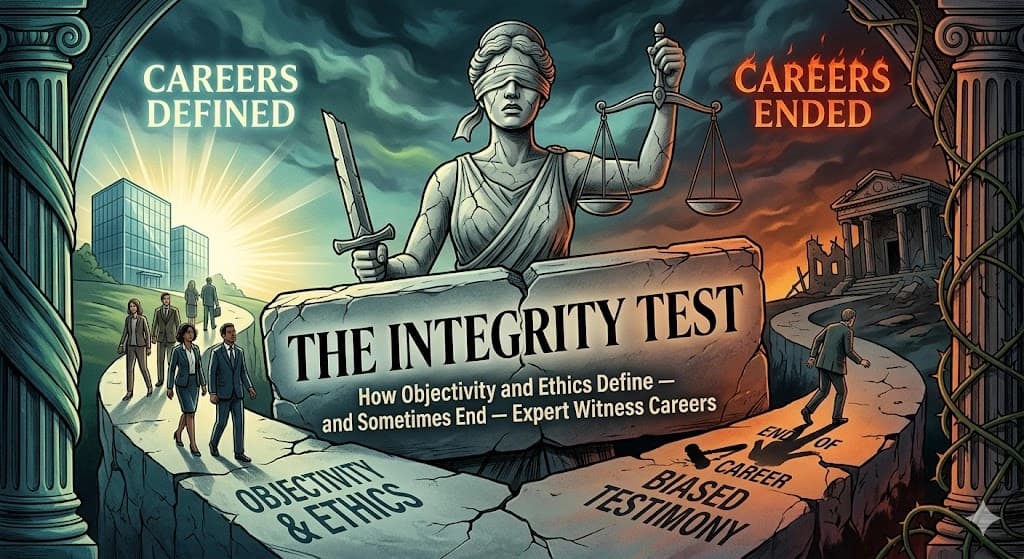
The integrity test is not passed once. It is passed every time an expert sits across from an attorney who needs a particular answer and provides an honest one instead. It is passed every time an expert declines a case they could probably get away with taking because it sits just outside the boundary of their genuine expertise. It is passed every time an expert writes an opinion that contains a finding the retaining attorney does not want to see, and delivers it anyway.
King captures what is at stake in each of these moments with characteristic directness. In anti-money laundering work, the expert's credibility is the entire product. The opinion has no value if the person delivering it is not trusted. "The second you have a bias, your credibility is gone forever." That word - forever - is worth considering carefully. The legal market does not forgive credibility failures easily. An expert who has delivered biased opinions accumulates a professional record that opposing counsel can read, that expert databases track, and that Daubert decisions enshrine in the public record. The integrity that takes a career to build can be compromised in a single case - and the damage does not stay in that case.
What all five of these practitioners share, across fields as different as anti-money laundering and emergency nursing, is a commitment to a principle that sounds simple but proves consistently difficult to maintain under professional pressure: the opinion reflects the facts, not the fee. The expert's obligation runs not to the attorney who retained them, not to the side of the case they are working on, but to the accuracy of their analysis and the honest application of their expertise to the question in front of them.
That obligation - and the discipline required to honor it through cross-examination, through findings that hurt the retaining party, through attorney pressure, and through the accumulated temptations of a long career - is what the integrity test asks of every expert who enters this profession. The ones who pass it, consistently and without exception, are the ones who build the careers that still command respect after five decades. The ones who do not find out quickly that credibility, once lost, is the one professional asset that cannot be rebuilt.
Conclusion
The legal system depends on expert witnesses to tell the truth. Not a version of the truth that is convenient for the retaining attorney. Not a technically accurate presentation engineered to survive Daubert while quietly serving advocacy. The actual, carefully examined, methodologically grounded truth - about how the money moved, about what the standard of care required, about whether the assumptions hold.
The experts who have built careers worth building - whose names circulate through attorneys' referral networks, whose opinions are respected even by opposing counsel, whose Daubert record is clean - are the ones who understood this from the beginning and never stopped acting on it. Their integrity is not a marketing claim or a professional slogan. It is the only thing they ever had worth selling. And in this profession, it is worth more than anything else.
Experts Featured in This Article
Richard Leisner - Season 2, Episode 11 | Corporate & Securities Law Expert Witness
Jonathan Klane - Season 3, Episode 11 | Certified Industrial Hygienist & Safety Expert
Dwayne King - Season 3, Episode 9 | Anti-Money Laundering & Financial Crime Expert
Pavithra Kumar - Season 3, Episode 2 | Finance, Securities & Damages Estimation Expert
Marilyn McCullum - Season 3, Episode 14 | Triple Board-Certified Emergency & Trauma Nurse Expert Witness