
The Ninety-Second Verdict - How Jurors Judge Before They Understand
Long before a jury evaluates the substance of what an expert says, they have already evaluated the expert. This is not a minor detail of courtroom performance. It is, according to the experts who have spent the most time on the stand, the dominant variable in how testimony gets received.
Dr. Stephen Cohen, a board-certified colorectal surgeon and medico-legal consultant who appeared on Season 3, Episode 1 of On The Stand, describes the phenomenon with a specificity that should reorder how every expert thinks about the first minutes of testimony. “Juries are no different than when you meet somebody,” he explains. “I mean, within the first 90 seconds of me on the stand, they’ve already determined that they like me or not.” By the time direct examination reaches its substantive questions, Cohen argues, the jury has already sorted him into a category - trustworthy or not, relatable or not - and everything he says afterward is filtered through that initial sort. “If I can get through that 30, 45 minute direct getting off the stand, drawing pictures, they already have an idea about me. Now comes the cross.” The cross-examination, in other words, rarely changes the jury’s mind about who the expert is. It mostly confirms or complicates a judgment that was made almost instantly.
Toni Elhoms, a medical billing, coding, and compliance expert who appeared on Season 3, Episode 6 of On The Stand, describes the same dynamic from the receiving end of an opposing attorney’s strategy. “At the end of the day, when you’re going in front of a jury, the only thing that they know about you is what you’re telling them verbally and non-verbally,” she says. Opposing counsel understands this better than most experts do. “Their entire job is to destroy your credibility, to make you look like the absolute worst person, to make you look like the hired gun. That’s the only thing that they know about you.” A jury has no independent access to an expert’s actual competence - no way to audit the methodology in real time, no way to check the calculations against a textbook. What they have is demeanor, tone, and the accumulated impression of ninety seconds multiplied across hours of testimony.
Jordan Redavid, a plaintiff trial attorney and founding partner at Fisher Redavid Trial Lawyers who appeared on Season 1, Episode 2 of On The Stand, adds a layer most experts never see from the witness stand: jurors arrive already primed with skepticism about paid testimony. Redavid has observed, through direct feedback from jurors on his own cases, what he calls “a negative correlation” between an expert’s volume of prior testimony experience and the credibility a jury extends to them. “When the juror hears that they’re your expert, they presume - and I think rightfully so - that they must be slanted your way in some way,” he says. “You’re paying them money, they’re giving an opinion, they’re never going to be truly objective.” In jurisdictions where jurors can learn how many times an expert has testified and how much they were paid, that information becomes what Redavid calls “a tipping point” - a threshold past which jurors stop weighing the substance of the testimony and simply discount it. “The sooner an expert can demonstrate to a jury that they’re a real person, they’re not an actor,” he says, “the better.”
What unites these three accounts is a finding that should be uncomfortable for anyone who believes expertise speaks for itself: it does not. A jury’s evaluation of an expert is substantially a social and psychological judgment, made rapidly and revised reluctantly, and it happens well before the jury has any real basis for evaluating the technical merit of what is being said.
The Jargon Wall - Why Technical Precision Can Backfire
If the first filter jurors apply is about the expert as a person, the second filter is about language — and it is here that the gap between what experts say and what jurors hear becomes most literal.
Michael Kaplan, a forensic accounting expert witness and co-founder of Courtroom Boot Camp who appeared on Season 1, Episode 3 of On The Stand, has heard the consequence of that gap directly from jurors themselves. “If any expert gets up there and starts speaking tech talk, speaking a language that many of the jurors don’t understand,” he warns, the result is not neutral confusion - it is active resentment. “I’ve heard jurors say, if you’re such an expert, why why can’t I understand what you’re telling me? The jurors are not experts in the same field that the expert witnesses are. The only reason the expert is there is that typical lay people, even highly educated lay people, don’t have the same background, don’t have the same experiential background.” For Kaplan, this is the central irony of expert testimony: the more technically fluent an expert becomes in their own field, the greater the risk that their language drifts away from the very audience their testimony exists to serve.
Dr. Simon Dardashti, a pain management and anesthesiology physician double board-certified in his specialty who appeared on Season 2, Episode 13 of On The Stand, locates the same principle in the etymology of his own title. “One of the meanings of the word doctor is teacher,” he points out, “and the same way in clinic I have to explain these kinds of concepts to patients so that they understand what’s going on with their body.” Testifying, for Dardashti, is not a separate skill from clinical practice - it is an extension of the same daily discipline of translating specialized knowledge for people who do not share it. Reflecting on what attorneys have told him they value most in an expert, he is direct about the hierarchy: “I don’t care about the credentials as much as I care about the ability to explain concepts, because at the end of the day you are a teacher to the jury, and if the jury can understand, can relate to you - that is the biggest quality in an expert that they look for.”
Dr. Cohen makes the same argument from a different clinical career, framing it in terms that are almost brutally simple. “If I can’t explain it to you in a way that you understand it, then I don’t understand it, right?” he says, describing a standard he learned not in medical school but from watching his mother, a schoolteacher, and from years spent training residents who had never performed a procedure before. “You have to put yourself in the position of talking to individuals that have no medical background, which is most juries, obviously, and limited knowledge from the attorneys.” The measure of expertise, in this framing, is not how precisely a concept can be stated in its native technical vocabulary. It is how completely that concept survives translation into plain language without losing its accuracy. An expert who cannot make that translation has not failed to communicate - according to Cohen, they have failed to actually understand their own material.
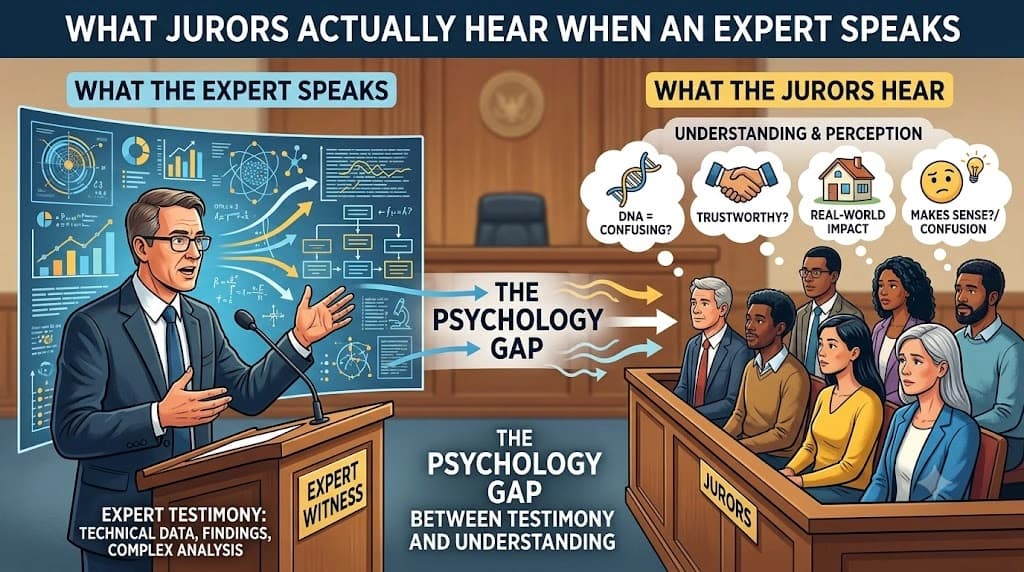
What Kaplan, Dardashti, and Cohen describe from three unrelated fields is the same cognitive reality: jurors do not process unfamiliar technical language by working harder to understand it. They process it by disengaging, distrusting, or filling the gap with whatever assumption feels intuitively right - which is precisely the outcome an expert is retained to prevent.
Story Over Statistics - How the Jury’s Brain Actually Retains Testimony
Beyond first impressions and plain language lies a third, deeper layer of the problem: even testimony that is delivered clearly and likably can fail to stick if it is structured the way experts naturally structure information - as a sequence of facts - rather than the way human memory actually retains information, which is as a narrative.
Kaplan has built an entire second career around this insight. Every technical case, he argues, contains the raw material of a story: a problem that existed, obstacles encountered along the way, an investigation conducted to resolve them, and a conclusion that answers the mystery. “Tell the jury how you went about doing your work and what were your challenges,” he advises experts. “I had a problem, this was the evidence, I need to, I went in, I spoke with the CEO of the company.” When an expert narrates the difficulties of their own analysis rather than presenting only the polished conclusion, something changes in how the jury relates to the material. “What I have found is the jurors embrace those problems and challenges as their own,” Kaplan says, “and they feel the intensity when the problem’s there, and then when the solution arrives - that Eureka moment - the experts feel it, the jurors feel part of it. That creates a bond, and that is critical in a trial.” He compares the structure explicitly to popular film: “It’s like the plot of a superhero movie—I really think that experts can be superheroes,” relatable people who encounter a problem, struggle with it, and ultimately resolve it in a way the audience can follow and root for. Presented as a sequence of numbers and formulas instead, Kaplan warns, the same analysis will “bore the jurors to death” - not because the content is weaker, but because the format gives the brain nothing to hold onto.
Robert Handfield, the Bank of America University Distinguished Professor of supply chain management at North Carolina State University who appeared on Season 2, Episode 10 of On The Stand, arrived at a parallel technique from a different direction: decades spent as a university educator explaining complex systems to students with no background in the subject. Testifying in a breach-of-contract case involving a failed warehouse management system, Handfield credits his teaching instincts with helping secure a fifty-one-million-dollar jury award. “I spent most of the time facing the jury, looking at the jury, and explaining to them what a supply chain is, how it operates, how do those principles apply to this case,” he recalls. Crucially, he paired that plain-language narrative with visual reinforcement: “The best way to do that is through visual displays, charts, graphs—those can take a lot of data and summarize it and show it in a picture that the jury can clearly observe for themselves.” He also anchored his analysis to sources the jury did not need to take on faith - Bureau of Labor Statistics data, the Census of Manufacturers - because, as he puts it, “there’s no other more objective party than the government.” A clear narrative arc, a visual aid the jury could inspect themselves, and third-party data are, in Handfield’s account, what made a technical logistics failure legible enough to justify damages at that scale.
Both accounts point to the same underlying mechanism: jurors do not retain isolated facts nearly as well as they retain a story with a beginning, a struggle, and a resolution - and evidence that can be seen, rather than only heard, sticks far longer than evidence that must be reconstructed from memory of spoken testimony alone.
The Skepticism Discount - Jurors as Active Judges, Not Passive Recorders
It would be a mistake to conclude from the sections above that jurors are simply waiting to be won over by the right story, the right visuals, and the right tone. Several of these same experts describe a jury pool that arrives deeply, structurally skeptical of expert testimony as a category - and that skepticism has to be actively managed, not merely charmed away.
Redavid’s “negative correlation” reflects a broader pattern he has observed across the insurance defense bar: attorneys who repeatedly recycle the same well-worn experts eventually trigger the distrust that produces the large, unpredictable verdicts the industry fears. “I think the defense suffers from what I just call is like you keep going back to the same well and drinking the same poisoned water,” he says. “I think in part it’s because the experts they keep parading in are so slanted in their favor - even if they’re not, the data says how could you not be, if they’ve used you a hundred times in ten years and paid you $8.2 million.” His own remedy is telling: he sometimes deliberately selects an expert with little prior testimony experience, reasoning that a credible first-time witness can out-perform a seasoned one, since the jury has no discovery record of repeat compensation to hold against them.
Elhoms describes the same skepticism from the perspective of an expert who has to survive it in real time. Opposing counsel’s entire strategy, she notes, is built around exploiting the jury’s default distrust: “That’s the only thing that they know about you - you’ve got to really be able to combat a lot of that.” Her approach is not to deny that she is paid, but to make her competence and consistency so evident - through public writing, teaching, and a track record attorneys can verify - that the “hired gun” framing fails to land. Cohen, for his part, treats a degree of adversarial banter during cross-examination as useful rather than threatening, precisely because it works against the caricature of the detached, mercenary expert: “It also allows the jury to see you as a human.” Jurors are not skeptical of experts in the abstract - they are skeptical of a specific narrative, that the expert is a paid mouthpiece, and that narrative is defused only through visible authenticity, not credentials alone.
When the System Passes the Buck - Judges, Juries, and the Limits of Lay Understanding
The gap between expert testimony and juror comprehension is not only a communication problem for individual witnesses. It is also, according to one of the field’s most prominent scholars, a structural feature of how the legal system itself handles science it does not fully understand.
Edward Cheng, an evidence law scholar who appeared on Season 2, Episode 15 of On The Stand, frames the challenge in terms that extend well beyond any single trial. “There’s a kind of fascination with how lay people, lay jurors, lay judges - how we can teach them about science in a very short amount of time,” he says, describing the puzzle that drew him from a science background into evidence law. His research suggests that judges, meant to act as gatekeepers under Rule 702, frequently decline to fully exercise that role - not from negligence, but because they, too, are lay evaluators of scientific reliability facing the same comprehension gap as the jurors they are supposed to screen. Reviewing court orders issued after the 2023 amendment strengthened judges’ gatekeeping obligations, Cheng found that more than half still relied on a piece of boilerplate reasoning - that a challenge “goes to the weight and not the admissibility” of the testimony - effectively passing the evaluation to the jury rather than resolving it at admissibility. “The burden is still being passed to the jury,” he observes. “I as a judge who’s fairly educated, I’m not going to determine this - you, the jury, twelve or whatever the size is, you figure this out.”
Cheng’s broader research points toward a partial remedy unrelated to any individual expert’s presentation skills: judges drawing on the “wisdom of crowds” - consistency across similar rulings by other courts - rather than each independently adjudicating scientific reliability from scratch. But the underlying diagnosis remains sobering. Kaplan, describing the same amendment from the expert’s side of the courtroom, notes that in a jury trial this scrutiny of methodology happens “before the jurors see anything” - the admissibility fight occurs outside their presence. Once testimony clears that bar, the jury is on its own, equipped with nothing but what the expert manages to communicate in the room. Gatekeeping protects against junk science reaching the jury at all. It guarantees nothing about whether legitimate science will actually be understood once it arrives.
What Actually Moves a Juror
Taken together, these accounts describe a jury’s experience of expert testimony as a layered filter, not a single evaluation. The first layer is social: an impression of trustworthiness formed within roughly ninety seconds, per Cohen, and rarely revised afterward. The second is linguistic: whether the expert translates specialized knowledge into language a lay person can follow, a discipline Dardashti and Cohen both trace to teaching rather than testifying. The third is structural: whether testimony is organized as a story with stakes and resolution, per Kaplan, reinforced with visual and independently verifiable evidence, per Handfield. The fourth is adversarial: a baseline skepticism about paid testimony that Redavid and Elhoms both describe managing rather than eliminating. Beneath all of it sits a fifth layer no individual expert controls - a system in which judges themselves, per Cheng, often decline to fully resolve the scientific questions Rule 702 assigns them, leaving jurors to adjudicate reliability questions they were never equipped to answer alone.
None of this diminishes the importance of rigorous methodology, sufficient facts and data, or reliable principles reliably applied - the requirements Rule 702 actually demands. It does mean that satisfying those requirements is necessary but not sufficient. An expert’s opinion can be flawless on the merits and still fail in the room, because the room is not evaluating the opinion the way the expert built it. It is evaluating a person, a story, and a translation - and only through those three things does the underlying analysis ever actually arrive.
Conclusion
The paradox that opened this article - a rigorously qualified expert, met with a juror’s blunt “why can’t I understand what you’re telling me” - is not a failure of that particular case. It is close to the default condition of expert testimony, and the experts featured here have each, in their own field, built a career around correcting for it. A colorectal surgeon learned it from his mother’s classroom. A supply chain professor learned it from years at a lecture podium. A forensic accountant built an entire training company around it. A trial attorney learned it by watching juries decide, within minutes, whom to trust. A pain physician learned it from the original meaning of the word doctor. A billing and coding expert learned it by surviving cross-examination designed to make her invisible. And a law professor learned, from the inside of the system itself, that even the judges meant to filter this problem out often decline to try.
What jurors actually hear when an expert speaks is rarely the testimony as the expert understands it. It is a translation, filtered through first impressions, plain language, narrative structure, and inherited skepticism, before a single fact ever has the chance to matter. The experts who understand that distinction do not treat communication as a soft skill layered on top of real expertise. They treat it as the only mechanism through which real expertise ever reaches a verdict at all.
Experts Featured in This Article
Michael Kaplan — Season 1, Episode 3 | Forensic Accounting Expert Witness & Co-Founder, Courtroom Boot Camp
Jordan Redavid — Season 1, Episode 2 | Plaintiff Trial Attorney & Founding Partner, Fisher Redavid Trial Lawyers
Robert Handfield — Season 2, Episode 10 | Supply Chain Management Expert & Distinguished Professor, North Carolina State University
Dr. Simon Dardashti — Season 2, Episode 13 | Pain Management & Anesthesiology Physician
Edward Cheng — Season 2, Episode 15 | Evidence Law Scholar & Professor
Dr. Stephen Cohen — Season 3, Episode 1 | Board-Certified Colorectal Surgeon & Medico-Legal Consultant
Toni Elhoms — Season 3, Episode 6 | Medical Billing, Coding & Compliance Expert
Position yourself where the legal industry looks for expertise - sign up on exlitem.com to get discovered by leading lawyers and high-value clients.