
Water Rights, Tribal Sovereignty, and the Climate Litigation Frontier
Few areas of American law carry the historical weight and contemporary urgency of tribal water rights. The legal framework governing these cases is built on nineteenth-century treaties, executive orders, and congressional acts - documents created in a world that could not have imagined the water stress that climate change is now imposing on communities across the American West. As those pressures intensify, the litigation they generate is becoming both more frequent and more consequential.
The intersection of historical evidence and contemporary legal disputes has created an entirely distinct expert witness discipline: the forensic historian. These are researchers who apply the rigorous methodology of academic historical scholarship to legal questions - tracing land use patterns, treaty negotiations, government correspondence, and tribal practices through documentary and ethnographic records to establish facts that courts must rely on to adjudicate rights that have been disputed for generations.
The stakes of this work are captured with striking clarity in the practice of Ian Smith, a principal historian and expert witness at Historical Research Associates who appeared on Season 3, Episode 15 of On The Stand. Smith specializes in Native American land and water rights, tribal sovereignty, and treaty interpretation, and has submitted expert reports and provided testimony in federal cases involving the water rights of the Coeur d'Alene tribe, the Gila River Indian community, the Akchin Indian community, and the Navajo Nation, among others. His research contributed to the Supreme Court's landmark decision in Herrera v. Wyoming, which upheld the Crow tribe's off-reservation hunting rights. In one case, his work helped the Interior Department's Solicitor determine that the MHA Nation owns the Missouri Riverbed - and the minerals beneath it.
The human dimension of this litigation is vivid. "There is a significant percentage of Navajo tribal members who do not have access to clean drinking water in their homes," Smith notes. The goal of tribal water rights litigation is not abstract legal recognition - it is what Smith calls "wet water": actual, physical access to water piped into homes. "That typically happens through water rights settlements rather than litigation," he explains, "so one reason why in a water rights context a lot of these cases don't go to trial." But when they do go to court, or when settlements require expert support, the historian becomes indispensable. Smith's process begins with the creation of the reservation itself - tracing how it was established, through treaty, executive order, or legislation - and then moves into decades of ethnographic literature documenting how the tribe used those lands and waterways before federal intervention. "We are all dealing with the impacts of climate change and diminishing water supplies across the West," he says. That pressure is not easing. Neither is the demand for historians who can reconstruct the record.
Criminal Nursing Cases - Where Malpractice Meets the Criminal Code
Medical expert witness work has long been dominated by physicians. But the legal system's demand for expertise about clinical care extends far beyond physicians - and one of the most rapidly growing and underserved areas involves nursing: what nurses knew, what they should have done, and in an emerging category of litigation, whether their actions crossed the line from civil malpractice into criminal liability.
The case that changed how the nursing profession understood its exposure to criminal prosecution was the 2022 trial of RaDonda Vaught, a Tennessee nurse who was criminally convicted after a medication error resulted in a patient's death. The case was not simply a malpractice matter. It was prosecuted as criminally negligent homicide - and it sent a signal to nurses, hospitals, and plaintiff attorneys across the country that the line between civil and criminal nursing liability had moved.
Few practitioners have been closer to the implications of that shift than Marilyn McCullum, a triple board-certified emergency and trauma nurse expert witness who appeared on Season 3, Episode 14 of On The Stand. McCullum holds certifications as a Certified Emergency Nurse, Certified Pediatric Emergency Nurse, and Trauma Certified Registered Nurse - credentials that put her in rare company among nursing expert witnesses. She wrote about the Vaught case and its implications for the legal nurse consulting community specifically because the shift it represented was generating confusion even among experienced practitioners. "Your world isn't as small as you think it is," she tells nurses considering expert witness work. "If you decide to do legal nurse work - consulting or expert work - you can look at criminal cases." The Vaught case, she says, was "a terrible teaching lesson" but one that has changed the landscape for nursing accountability and, by extension, for the expert witnesses who testify about what nurses should have known and done.
What makes McCullum's practice particularly distinctive in an era when currency of clinical knowledge matters more than ever is that she continues to work clinically 32 hours per week while running her expert witness practice. In the ER, every shift is current training - she is not drawing on what emergency nursing looked like ten years ago, but on what it looks like this week. That current hands-on experience, she argues, is exactly what many attorney clients need most. An expert who can say "I was in the emergency department last Tuesday, and here is what the standard practice looks like" carries a credibility that a retired clinician cannot match. Her bilingual capability in English and Spanish is an additional differentiator: as the demographic composition of patients in American emergency departments evolves, the ability to assess care provided to Spanish-speaking patients - and to explain clinical nuance to Spanish-speaking families in litigation - is a genuine professional edge.
Insurance Coverage Disputes - A 50-Year Expert Watches the Field Transform
Insurance coverage litigation is not a new field. Disputes between policyholders and insurers over what a policy covers, how exclusions apply, and whether a claim was handled in good faith have occupied courts for as long as insurance has existed as an industry. But the nature of those disputes is changing - driven by the emergence of new risk categories, new policy forms, and new industries whose liability exposure the insurance market has had to develop frameworks to address. That evolution requires experts who have been inside the industry long enough to understand not just the current state of coverage law but the historical trajectory that produced it.
Few figures in the insurance expert witness world have a longer or more distinctive vantage point than Frederick Fisher, an insurance and professional liability expert who appeared on Season 3, Episode 13 of On The Stand. Fisher has been called many things over his 50-year career in insurance - including, memorably, the "coverage terrorist" - but his defining professional commitment is to the truth of what a policy says and means, regardless of which side retained him. He has worked on more than 300 cases since 1988, testified in over 50 depositions and 25 trials, and maintains a deliberate balance of plaintiff and defense work specifically to preserve his objectivity. "I really think the role of an expert - the one - is to be as neutral as possible," he says. "I really don't care if the plaintiff wins or the defense wins. I care about what's true."
Fisher's 50-year perspective illuminates how substantially the coverage landscape has shifted. Cyber liability - the insurance coverage for data breaches, ransomware attacks, and fraud enabled by social engineering - represents one of the clearest examples of an area where policy language has not kept pace with the risks it is supposed to cover. The same policy form interpreted in two different states can produce opposite coverage outcomes for the same event. "An insurance company's cyber liability policy - in one state, there's no coverage for social media fraud, i.e., wiring money to somebody because you thought it was the president," Fisher explains. "And then another state said, same policy, but we believe that it is covered." As cyber claims have proliferated, the interpretive disputes they generate have created sustained demand for experts who can explain policy intent, industry custom and practice, and claims handling standards to judges and juries who have no background in insurance.
The professional liability area - covering errors and omissions for lawyers, accountants, architects, engineers, and miscellaneous professionals - is another category where coverage complexity and the evolving understanding of professional duty are generating an expanding stream of expert witness engagements. Fisher has been a founding and leading figure in the Professional Liability and Underwriting Society and authored the definitive text on claims-made insurance policies. That combination of industry authority and litigation experience makes him exactly the kind of expert a coverage dispute requires: someone who can translate the arcane language of professional liability insurance into terms a court can use to decide who bears responsibility for a complex claim.
Addiction Medicine - Fentanyl, Cannabis, and the Litigation Wave That Followed
The opioid epidemic generated a wave of litigation that will take decades to fully resolve. But even as those cases work through the courts, new fronts in addiction-related litigation are opening - driven by fentanyl's infiltration of every illicit drug supply, the rapid expansion of cannabis legalization, and the growth of private addiction treatment facilities whose standards of care have not always kept pace with the patients they serve.
The data framing this litigation landscape is stark. The fentanyl crisis has driven overdose death rates to levels that were unthinkable a generation ago - approximately 82,000 Americans died of overdoses in 2023 according to CDC data. Those deaths are not evenly distributed: many occur in addiction treatment facilities, during the period of greatest vulnerability when a patient's tolerance has been lowered after a period of sobriety. When a patient relapses in a treatment facility and dies of a fentanyl overdose, the question of whether the facility met the standard of care becomes a wrongful death litigation question - one that requires an expert who can explain both addiction pharmacology and clinical standards of care in behavioral health settings.
The intersection of these clinical and legal questions is the daily professional territory of John Puls, a clinical social worker and addiction specialist who appeared on Season 2, Episode 4 of On The Stand. Puls has testified in high-profile wrongful death cases involving addiction treatment facilities and stays at the cutting edge of research on cannabis-induced psychosis and fentanyl overdose patterns. "Because of those factors, I've seen a large growth in civil litigation related to wrongful death," he says. "And I will add - this is not just in addiction treatment, but also in mental health facilities." He describes a specific structural vulnerability in the addiction treatment industry: the simultaneous expansion of insurance coverage under the Affordable Care Act, the ramping of the opioid crisis, and the rapid growth of private equity-backed treatment facilities created conditions where growth outpaced quality. Not every facility that opened adhered to the best standard of care. And the population being served - people with substance use disorder at their most vulnerable - had the least capacity to advocate for themselves when standards slipped.
Drone Forensics and the Digital Reconstruction of What Happened
Accident reconstruction is one of the oldest forms of expert witness work. But the technological tools available to reconstruction experts have changed so dramatically in the past decade that the field bears little resemblance to what it was when most of its practitioners were trained. Drones, LiDAR sensors, photogrammetry software, and three-dimensional point cloud modeling have transformed what is knowable about an accident scene - and what an expert can present to a jury.
The integration of drone technology into forensic practice requires a qualification that most accident reconstruction engineers do not hold: an FAA Part 107 commercial drone pilot certificate. The training covers airspace regulations, flight clearances, operational safety, and the legal framework governing commercial drone operations. Without it, a reconstruction expert cannot legally conduct the aerial investigation that modern evidence collection increasingly requires. The expert who holds it occupies a position of distinct competitive advantage.
That advantage is described in precise technical terms by John Zeirke, a mechanical engineer and accident reconstruction expert who appeared on Season 3, Episode 12 of On The Stand. Zeirke is FAA-certified as a commercial drone pilot, and he describes what aerial investigation makes possible that ground-level work cannot. "Getting a good aerial view right over is a really good way - then you can put it into software and be able to have your scale model," he explains. Drone-mounted LiDAR, he notes, is advancing toward the point where it can replace or complement the large fixed Faro scanners that currently represent the gold standard in scene measurement: "As that technology continues to advance, there'll be more and more LiDAR capability that can actually replace or at least complement the large Faro scanners that are really the gold standard in terms of collecting point cloud data." The combination of drone footage and software that can merge aerial and ground-level images allows reconstruction experts to measure accurate distances from photographs that would previously have been considered too imprecise to be usable. Cases involving agricultural equipment, bridge impacts, and freight damage - previously difficult to reconstruct because of the scale and complexity of the scenes - become accessible when aerial perspective is available. The frontier of what accident reconstruction can establish in court is being redrawn in real time.
The Medical Research Librarian - Filling the Gap at the Center of Complex Litigation
Perhaps the most counterintuitive expert witness role to have emerged in modern litigation is one that has been invisible in plain sight for years: the medical librarian. As pharmaceutical litigation, medical device cases, and multi-district litigation have grown in complexity, the volume of published scientific literature relevant to any given dispute has grown with them. A single MDL case may involve thousands of peer-reviewed studies. No clinician, however expert, can systematically navigate that literature in the time litigation requires. No attorney has the database access or research methodology to do it either. The gap is real, and it has created a distinct professional opportunity.
The story of how this role came into focus for one practitioner illustrates how litigation demand creates new expert categories. When a boutique law firm of three attorneys found themselves drowning in more than a thousand medical studies related to a failed medical device, they did not call a physician. They called a medical librarian. Michael Graham, a medical librarian and litigation research consultant who appeared on Season 3, Episode 4 of On The Stand, describes receiving that first call with no idea it was coming. "I wasn't listed anywhere. I didn't know that this was a need that was out there." The law firm, handling a complex malpractice case where the device had failed and the physician may have compounded the harm, was dealing with over a thousand studies and publications. "They were drowning in the medical literature," Graham recalls. "They just needed a lot of help with specialized medical research. They didn't have access to the databases." He worked the case, loved it, and recognized immediately that he had stumbled into a professional gap that was not going to close: "There's a human being on the other end of this information that I'm providing, and there's a story there." As MDL cases grow and published medical literature continues to expand, the medical librarian who can conduct rigorous systematic reviews, locate every relevant study, and organize a literature base that expert witnesses and attorneys can use is not a support function. They are a specialized expert category of their own.
The Pattern Behind the Frontiers
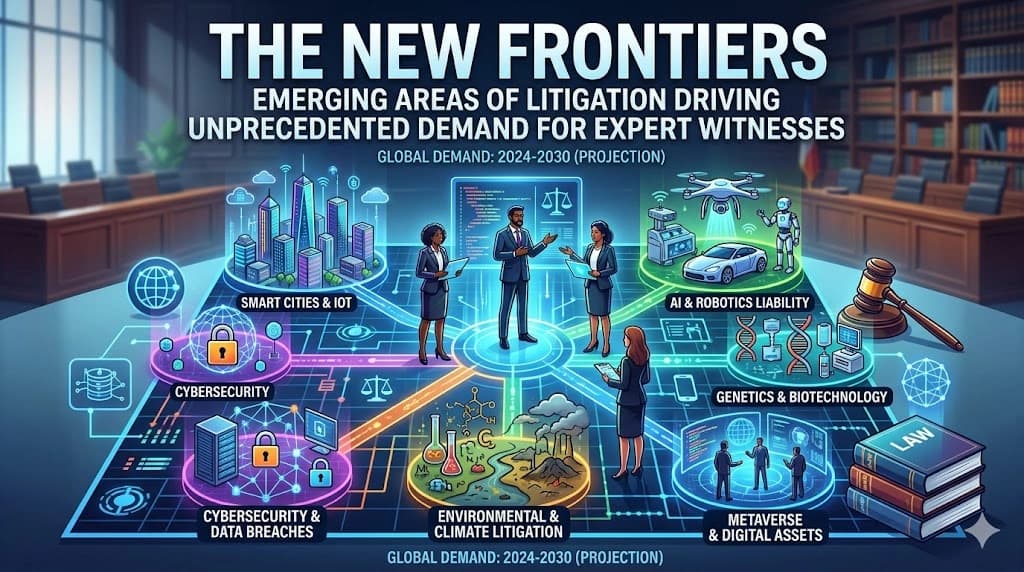
What these six emerging litigation areas share - water rights, criminal nursing, insurance coverage, addiction medicine, drone forensics, and medical research - is a common structure. Each one was created or dramatically accelerated by external change: climate pressure on water supplies, a single criminal prosecution that redrew professional liability for nurses, new policy forms struggling to keep pace with cyber risks, a public health crisis that overwhelmed an underprepared treatment industry, a technology that transformed what forensic investigation can establish, a scientific literature base that outgrew the legal profession's capacity to navigate it.
In each case, the legal system arrived after the change had already happened - seeking expertise that barely existed as a litigation specialty and finding that the pool of qualified, willing experts was far smaller than the demand required. Ian Smith describes working at the intersection of historical methodology and treaty law in a field where few practitioners have built both the research depth and the courtroom credibility his cases require. Marilyn McCullum works a nursing expert witness niche where her triple board certifications and current clinical practice put her in what she describes as "rare company." Frederick Fisher has spent 50 years watching coverage disputes evolve - and notes that the complexity of cyber liability and professional liability policy interpretation is generating questions that require historical knowledge of the industry that most experts simply do not have.
For professionals in emerging technical and scientific fields who are wondering whether their expertise might be relevant to litigation: the question is not whether the legal system needs what you know. It almost certainly does. The question is whether you are visible enough, credible enough, and willing enough to be found when an attorney faces a case that only you can help resolve. In every frontier described in this article, that discovery happened the same way: an attorney had a problem that no one on their existing roster could solve, and someone who had never thought of themselves as an expert witness answered a call that changed the trajectory of their career.
The legal system is a reactive institution. It responds to harm after it occurs. And every new category of harm eventually generates a search for the one person who understands it well enough to explain it to a court. The expert who is ready when that search begins does not just fill a professional need. They shape how the law itself develops in a field that the courts are encountering for the first time.
Experts Featured in This Article
Ian Smith - Season 3, Episode 15 | Expert Witness Historian, Native American Land & Water Rights
Marilyn McCullum - Season 3, Episode 14 | Triple Board-Certified Emergency & Trauma Nurse Expert Witness
Frederick Fisher - Season 3, Episode 13 | Insurance & Professional Liability Expert
John Puls - Season 2, Episode 4 | Clinical Social Worker & Addiction Specialist
John Zeirke - Season 3, Episode 12 | Mechanical Engineer & Accident Reconstruction Expert
Michael Graham - Season 3, Episode 4 | Medical Librarian & Litigation Research Consultant