
Why This Bill Exists
India's arbitration framework has been amended three times since the principal Arbitration and Conciliation Act, 1996 was enacted - in 2015, 2019, and 2021. Each round addressed specific pressure points. The 2015 amendments were transformative: they introduced time limits, curbed court intervention, and made interim awards enforceable. The 2019 amendments created the Arbitration Council of India and introduced protections for arbitrator independence. The 2021 amendments narrowed automatic stays of awards.
Yet the system remained slower, costlier, and more court-entangled than India's ambitions as an international arbitration seat demanded.
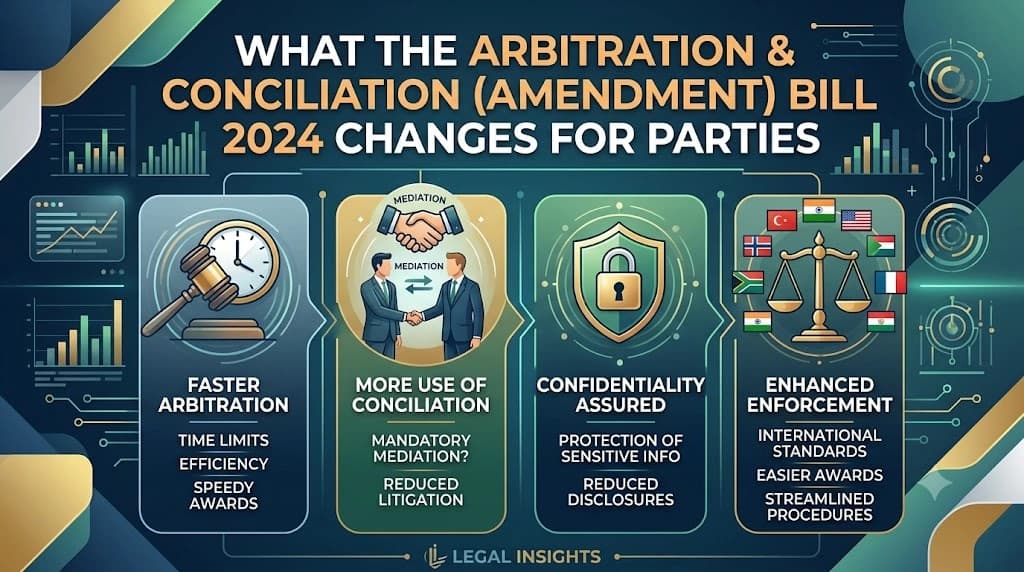
In October 2024, the Department of Legal Affairs under the Ministry of Law and Justice published a fresh consultation draft - the Arbitration and Conciliation (Amendment) Bill, 2024 - inviting public comments. The draft grew from the work of an expert committee chaired by Dr. T.K. Viswanathan and pursues three core objectives: promote institutional arbitration, reduce court intervention further, and speed up the arbitral process from commencement to enforcement.
As of mid-2026, the Bill has not been introduced in Parliament and has not been enacted. The operative statute remains the 1996 Act as amended. The text that eventually reaches Parliament - if it does - may differ materially from the October 2024 draft. That said, the proposals are substantive enough to shape how parties draft arbitration clauses, select institutions, and anticipate challenge strategies today.
This article walks through the most consequential proposed changes for parties and their advisers.
1. Emergency Arbitrators: Urgency Gets a Statutory Home
Perhaps the most practically significant proposal is the introduction of emergency arbitration through a new Section 9-A.
Currently, if a party needs urgent interim relief - to freeze an asset, preserve evidence, or prevent a contractual breach - before an arbitral tribunal is constituted, their only statutory option is to approach a court under Section 9. That process, even in commercial courts, can take weeks or months. Some institutional rules already provide for emergency arbitrators, but without statutory backing, the enforceability of emergency orders has been uncertain.
The Draft Bill changes this. Once arbitral proceedings have commenced but before a tribunal is constituted, a party may apply to the arbitral institution for an emergency arbitrator. The emergency arbitrator's order would be enforceable in the same manner as an order of the tribunal. The arbitral tribunal, once constituted, would have the power to confirm, modify, or vacate the emergency order.
What this means for parties: Urgent commercial relief - injunctions, asset freezes, evidence preservation - moves from overloaded courts into the arbitral framework where parties have already chosen to resolve their disputes. For cross-border transactions, this alignment with international institutional norms (ICC, SIAC, LCIA rules already have emergency arbitrator provisions) is particularly welcome; it reduces the argument that India-seated arbitrations are institutionally inferior for time-sensitive disputes.
The practical gap: The Bill does not address how quickly an emergency arbitrator must be appointed, what constitutes sufficient urgency, or what the fee structure looks like. Institutions will need to fill these gaps in their rules. Until that jurisprudence develops, parties should expect some uncertainty in the first years of operation.
2. The Appellate Arbitral Tribunal: Reducing Court Load or Creating Parallel Tracks?
The most debated proposal in the Draft Bill is the introduction of an Appellate Arbitral Tribunal (AAT) through a new Section 34-A.
Under the current regime, a party wishing to challenge a final award must file an application before the competent court under Section 34. Disposal of these applications takes, on average, three to four years in Indian courts. This delay is a systemic problem: it means parties are locked in post-award litigation even when the arbitration itself was conducted efficiently.
The Draft Bill proposes a fundamental restructuring. Arbitral institutions will be empowered to provide in their rules for an Appellate Arbitral Tribunal. Where parties have opted into an institutional framework with AAT rules, a Section 34 challenge would be decided by the AAT - to the exclusion of the seat court. Judicial intervention would then be limited to appeals under Section 37 and appeals before the Supreme Court.
The stated rationale is sound: if parties chose arbitration to avoid courts, why should every award challenge end up in one? An appellate mechanism within the arbitral framework could deliver faster decisions, with arbitrators or specialists resolving technical disputes more efficiently than generalist judges.
The enforcement gap: Here the drafting creates a real problem. The Bill does not amend Section 36, which governs the stay of an arbitral award during challenge proceedings. Section 36 vests that power in the "court." A conjoint reading of the proposed Sections 34, 34-A, and 36 produces an absurd result: a party can challenge an award before the AAT, but must simultaneously approach a court to obtain a stay of that same award. This creates multiplicity of proceedings at precisely the moment the Bill aims to streamline them.
The dual-track problem: For ad hoc arbitrations without institutional rules, and for cases where parties have not opted into an AAT mechanism, Section 34 challenges will continue to go to courts. This creates two parallel regimes - one governed by the AAT, one by courts - with potentially divergent jurisprudence on what constitutes grounds for setting aside an award. Over time, this could produce inconsistency in how key concepts like "public policy" and "patent illegality" are interpreted.
The Supreme Court's concern: The Hon'ble Supreme Court of India has reportedly flagged gaps in the 2024 draft and urged the Ministry of Law and Justice to address them. This is a notable signal. If the highest court has reservations about the institutional architecture, the Bill will need significant revision before it can be enacted without generating immediate constitutional or jurisdictional challenges.
What parties should do now: Even before enactment, parties negotiating arbitration clauses for India-seated disputes should consider explicitly addressing which forum will handle set-aside applications, and ensure their chosen institution has - or is developing - robust AAT rules.
3. Institutional Arbitration Gets Stronger: New Powers for Arbitral Institutions
The Draft Bill shifts significant powers currently held by courts to arbitral institutions. This is a structural recalibration worth understanding.
Under the current Section 29-A, courts have the power to extend the time limit for making an award, order a reduction in arbitrators' fees where delays are caused by the tribunal, and substitute arbitrators. The Draft Bill proposes moving all three of these powers to arbitral institutions.
Why this matters: Court applications under Section 29-A have themselves become a source of delay and satellite litigation. Transferring these powers to institutions - which can act administratively and quickly - removes a category of court filings entirely. Institutions are also better placed to assess whether a delay is attributable to the tribunal or to the conduct of the parties.
The caveat for ad hoc arbitration: This shift benefits institutional arbitration almost exclusively. Parties in ad hoc arbitrations will still need court intervention for extension, fee reduction, and substitution. This asymmetry creates a strong practical incentive to choose institutional frameworks - which is presumably the policy intent.
4. Partial Annulment: Surgical Precision in Setting Aside Awards
One of the more technically sophisticated proposals is the introduction of partial annulment of awards through a new Section 34(7).
Currently, when a court sets aside an award under Section 34, the entire award is typically vacated and the matter referred back to the tribunal for fresh consideration — even if only one issue within a multi-issue award is defective. This is inefficient and commercially damaging where parties have obtained a sound determination on most issues.
The Draft Bill draws a distinction between grounds that warrant setting aside an award entirely and grounds for partial annulment. Where an award is partially set aside, only the contested issues need to be reconsidered by the tribunal. Sound portions of the award are preserved and can be enforced.
What this means in practice: In complex commercial arbitrations - construction disputes with multiple delay heads, M&A disputes with several warranty claims, joint venture disputes spanning different tranches - this is a material improvement. A party who has secured a correct determination on eight of ten issues should not lose all of that because the tribunal erred on two.
India's alignment with international norms: Partial annulment is available under many civil law jurisdictions and is consistent with Article 34 of the UNCITRAL Model Law as interpreted in several common law jurisdictions. The proposal brings India closer to mainstream international practice, which will matter in disputes where foreign parties or foreign-seated parallel proceedings are involved.
5. Digitalising Arbitration: Online Proceedings Get Statutory Recognition
The Draft Bill updates the definition of arbitration to include proceedings conducted wholly or partially through electronic means - audio-visual hearings, digital document exchange, and online proceedings.
This codifies what pandemic practice made universal. Indian arbitral institutions and tribunals had already adapted. But without a clear statutory basis, parties in enforcement proceedings - particularly in foreign jurisdictions - faced arguments that online-conducted arbitrations were procedurally irregular.
For cross-border disputes: Statutory recognition of digital arbitration strengthens the enforceability of India-seated online arbitrations before foreign courts and under the New York Convention framework.
Practical note for parties: Arbitration clauses should now explicitly address the institution's rules on electronic proceedings rather than relying on ad hoc agreement during the arbitration itself.
6. Speeding Up Commencement: The Section 9(2) Change
Section 9(2) currently provides that a party who obtains a pre-arbitral interim order from a court must commence arbitration within 90 days of the date of that order. The Draft Bill proposes starting that 90-day clock from the date of filing the Section 9 application - not the date the order is passed.
The practical effect: parties can no longer use prolonged Section 9 proceedings as a delay tactic. If a Section 9 application takes six months to be decided (not unusual in congested commercial courts), the party has already consumed much of its 90-day window.
Critical point for practitioners: This change requires a rethinking of how Section 9 applications are sequenced. Parties should be preparing to formally commence arbitration almost simultaneously with filing interim relief applications, rather than waiting for a court order before starting the arbitral clock.
7. Interest on Awards: The Repo Rate Shift
The Draft Bill modifies how interest is calculated on sums directed to be paid under an arbitral award.
Currently, Section 31(7)(b) sets post-award interest at 2% above the "current rate of interest prevalent on the date of award" - an undefined benchmark that has led to inconsistency.
The proposed amendment anchors post-award interest to 3% above the Reserve Bank of India's prevailing repo rate on the date of the award.
Why this is a meaningful change: The repo rate is precise, publicly available, and unambiguous. Linking interest to a clearly defined RBI benchmark removes a source of disputes at the enforcement stage. At current repo rates (the RBI repo rate has fluctuated between 6% and 6.5% in recent years), the practical difference may be modest — but the elimination of uncertainty is valuable.
8. Stamping of Awards: Closing an Enforcement Loophole
The Draft Bill requires arbitral awards to be stamped under Section 31(1). This addresses a recurring problem: unstamped awards have been challenged at the enforcement stage under the Indian Stamp Act, creating delays that undermine the finality of arbitral decisions.
The Supreme Court's constitution bench decision in NN Global Mercantile Pvt. Ltd. v. Indo Unique Flame Ltd. and subsequent jurisprudence made unstamped arbitration agreements a live issue. Mandating stamped awards is a logical extension - and should be accompanied by clear guidance on stamp duty rates across states to avoid the current patchwork.
9. Conciliation Moves Out: A Renamed Act
The Draft Bill proposes omitting the conciliation provisions from the 1996 Act entirely, on the basis that the Mediation Act, 2023 now covers that ground. If enacted, the statute would be renamed simply the "Arbitration Act, 1996."
For practitioners: Existing contracts that refer to the "Arbitration and Conciliation Act, 1996" by name should be reviewed. For new agreements, counsel should specify the Arbitration Act (and separately the Mediation Act where appropriate) to avoid any ambiguity once the renaming takes effect.
What the Bill Gets Right - and Where It Falls Short
The 2024 Draft is the most ambitious reform proposal since 2015. It correctly diagnoses the main pathologies: emergency relief mechanisms are absent from statute, institutional arbitration lacks teeth, award challenges clog courts, and the law has not kept pace with digital practice.
But implementation design matters as much as policy intent.
The AAT proposal - the centerpiece of the draft - has a structural flaw in the Section 36 gap that could produce the very multiplicity of proceedings it seeks to eliminate. This must be fixed before enactment. The dual regime for institutional versus ad hoc arbitrations risks fragmentation of jurisprudence. And the reduced limitation periods - 60 days for arbitrator appointment in some contexts - may be unrealistic for complex multi-party disputes.
Critics with standing, including practitioners and reportedly members of the Supreme Court, have raised these concerns. The Ministry will need to recalibrate the draft significantly before it reaches Parliament.
What Parties and Counsel Should Do Now
The Bill is not law yet. But its direction is clear. India is moving deliberately toward a world where institutions have more power, courts have less, digital proceedings are normal, and emergency relief is available within the arbitral framework.
Parties should act accordingly:
Review arbitration clauses in existing and new contracts. If you are seated in India, choose a recognised institution (MCIA, IAMC, IIAC, or GIFT City) whose rules will evolve to incorporate the new statutory powers when enacted.
Build in flexibility on online proceedings explicitly, rather than relying on institutional rules alone.
Sequence Section 9 applications carefully. Under the proposed amendment, the 90-day commencement window starts from filing brief your team to be ready to commence arbitration simultaneously.
Watch the Parliament calendar. The Bill could reach Parliament in the winter 2026 session. Once tabled, the timeline to enactment could be short.
Takeaway
The Arbitration & Conciliation (Amendment) Bill 2024 is the most consequential proposed reform to India's arbitration framework in a decade. Emergency arbitrators, appellate institutions, partial annulment, and digital proceedings each address real deficiencies. The ambition is right. But the enforcement gap in the AAT mechanism, the dual-track problem, and several procedural ambiguities need resolution before this Bill can deliver on its promise of a faster, leaner, court-light arbitration ecosystem.
For parties using India-seated arbitration whether in construction disputes, M&A, joint ventures, or financial contracts now is the time to audit your arbitration architecture and position for the world this Bill is trying to create.
Position yourself where the legal industry looks for expertise - sign up on exlitem.com to get discovered by leading lawyers and high-value clients.