
The Criteria Attorneys Never Publish
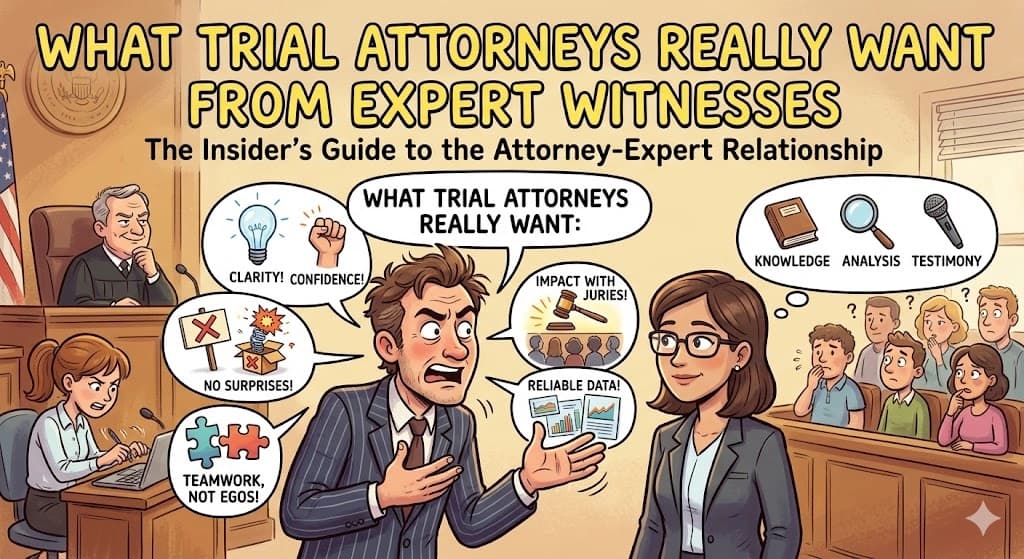
Every attorney has a list of what they say they're looking for in an expert witness: the right credentials, a clean Daubert history, published research, relevant case experience, and the ability to withstand cross-examination. These are the formal criteria-the things attorneys write into their intake forms when they post to expert directories.
Then there are the real criteria.
Attorney Alvin Wolff (Season 2, Episode 5 - Personal Injury & Medical Malpractice, with over 7,000 resolved cases and 40-plus years of practice) is candid about what he's really evaluating: whether an expert can do the job the case actually requires—not just the job their CV suggests they can do.
In Missouri, where Wolff practices, an expert affidavit is legally required before a medical malpractice case can even be filed. You must have someone who can attest to a deviation from the standard of care before the complaint goes in. That's not a preference - it's the law. When the stakes are that high, the informal test kicks in immediately: Is this the right person? Do they understand what I actually need?
Wolff prefers to get experts involved early - "particularly for premises cases and medical malpractice cases" - precisely because early involvement gives him time to evaluate the expert as a collaborator before the relationship is stress-tested by a looming deadline.
Alvin Wolff (Season 2, Episode 5 - Personal Injury & Medical Malpractice Attorney) says he engages experts before cases are filed for complex premises and malpractice matters—giving him time to assess the relationship before pressure sets in.
The informal criteria that animate that early assessment are harder to articulate but instantly recognizable: Does this person understand what the attorney is trying to accomplish? Are they responsive? Can they explain complex concepts in plain language? Will they stay committed when things get uncomfortable?
That last question - commitment under pressure - is precisely what failed in Jon Groth's cautionary tale about the orthopedic surgeon. The expert looked right on paper. The relationship held during the easier early phases. It collapsed when the case became real.
Jon Groth (Season 2, Episode 14 - Personal Injury & Vaccine Injury Attorney) advises attorneys to anticipate the 'cold feet' risk by having backup experts lined up and by choosing treating physicians who have demonstrable prior experience surviving the pressure of trial.
The Case for Getting In Early
One of the most consistent pieces of advice that attorneys and experts give - from opposite sides of the relationship - is deceptively simple: bring the expert in early. Not at the point of filing. Not after discovery closes. Early.
Alvin Wolff explains why from the attorney's perspective. In a premises liability case with ADA requirements or complex building code issues, an attorney who doesn't specialize in construction, engineering, or architecture needs an expert not just to testify - but to understand the landscape before making any decisions about the case. The expert helps the attorney know what to look for, what to request in discovery, and whether there's a viable case to begin with.
"A lot of times in a premises case you may have some special ADA requirements or building code requirements and I'm not an expert in construction or engineering or architecture so it's good to have someone take a look at the file."
Jon Groth echoes this from his vaccine injury and personal injury practice. The worst outcomes in his experience come from cases where the expert was brought in as a late-stage validator rather than an early-stage collaborator. When an expert arrives after the complaint is filed, after depositions are taken, and after the case theory is set in stone, they're constrained in ways that limit their usefulness - and increase their risk of finding out the hard way that there's no case to win.
From the expert side, the benefits of early involvement are just as significant. K. David Meit - a Certified Property Manager and real estate property management expert witness with over three decades of experience (Season 2, Episode 3) - notes that early engagement allows him to understand what a case genuinely involves before committing to a theory, before writing a report, and before being deposed on positions he may not have fully had time to develop.
K. David Meit, CPM® (Season 2, Episode 3 - Real Estate & Property Management Expert Witness) emphasizes that understanding the legal framework and the structure of expert reports is not optional - it shapes how he engages with cases from the first call.
For Meit, knowing enough about the law to understand how a report functions - what it defines, what it limits, and what it protects - isn't about becoming a lawyer. It's about being useful as an expert witness. As he puts it: he doesn't need to know how to fix an HVAC system, but he needs to know enough to be able to explain why a property manager who ignored the maintenance reports was acting below the standard of care.
Early involvement also protects the expert's independence. When an expert is brought in at the last minute, there's pressure - sometimes overt, more often subtle - to adapt their opinion to the case theory already in place. Early involvement means the expert has the time and space to form independent opinions before the attorney's theory is fully baked.
The Independence Paradox: Collaboration Without Compromise
One of the most persistent tensions in the attorney-expert relationship is the question of how collaborative it should be. Attorneys need experts who understand the case well enough to be useful. But experts who become too embedded in the attorney's theory risk compromising the independence that makes them credible in the first place.
Jerry Birnbach - a retail design and safety expert with over fifty years of industry experience and more than 650 litigation cases involving slip-and-fall, premises liability, and commercial injury claims (Season 2, Episode 2) - has navigated this tension across hundreds of attorney relationships.
Jerry Birnbach F.I.S.P., Assoc. AIA (Season 2, Episode 2 - Retail Design & Safety Expert Witness) has consulted on more than 650 cases for clients including Walmart and Target, and brings a practitioner's perspective on where retail safety accountability really lies.
Birnbach describes how most attorneys handle this well. In nearly thirty-five years of expert witness work, he says roughly ninety-nine percent of the attorneys he has worked with have not tried to sway his opinion. They explain the case. They share the depositions. They want his professional assessment - and then they let him make it.
"They don't try to influence me in the very beginning. Some attorneys will tell you their feelings about the case, but they for the most part do not try to sway me one way or another. They want to get my opinion in terms of: do you think there's liability or not?"
But Birnbach is also clear that there are economic realities that affect the dynamic. Smaller firms tend to be more budget-conscious and more directive about managing the scope of his work. That's not inherently problematic-it's a business reality. What becomes problematic is when budget constraints compress the time an expert has to properly review materials and form an independent opinion.
The one percent of attorneys who do try to influence the process create problems that typically surface at deposition. One of the first questions opposing counsel will ask is whether the retaining attorney explained the nature of the case at the outset. When experts have allowed themselves to be steered, the cracks show under pressure.
K. David Meit adds another dimension to this issue. He's encountered attorneys who, perhaps out of habit or confidence in their own legal theory, want to act as the expert rather than work with one - telling him what conclusions to reach rather than asking for his analysis. These relationships rarely produce credible testimony. Trial lawyers, Meit observes, understand that a courtroom is theater: the expert is one of the performers, and their credibility is the product. When attorneys undercut that credibility by scripting the performance, they undercut their own case.
How to Prepare an Expert—and What Goes Wrong
Deposition preparation is where the attorney-expert relationship is most intensely tested. Both sides arrive with different anxieties. The attorney worries about the expert saying something off-script that blows up the case. The expert worries about being blindsided by questions they weren't told to expect. The best preparation sessions address both fears honestly.
John Puls—a licensed clinical social worker, addiction specialist, and expert witness in addiction-related wrongful death and personal injury cases, and founder of Puls Therapeutic Solutions (Season 2, Episode 4) - recalls the experience of preparing for his first deposition with vivid specificity.
John Puls, LCSW (Season 2, Episode 4 - Addiction & Mental Health Expert Witness) has testified in high-profile cases involving substance use disorder and wrongful death. He also teaches crisis intervention at Florida Atlantic University and specializes in cannabis-induced psychosis.
He had done preparation of a kind. He had read the relevant materials. He felt prepared - or thought he did. But nothing fully prepares an expert for the first cross-examination. The style of questioning at deposition is structurally different from the collaborative conversations an expert has during case development: the pace is designed to be disorienting, the questions are designed to elicit yes-or-no answers, and the goal is to expose the edges of the expert's opinion.
What Puls learned - and what he now emphasizes when advising newer experts - is that genuine preparation involves understanding not just the substance of your opinions, but the shape of the cross. What are the most vulnerable points in the opinion? What will opposing counsel try to establish first? Which concessions can be made without damage, and which cannot?
The best attorneys he has worked with understand this. They walk through the likely attack vectors with the expert before the deposition, not to coach the answer but to make sure the expert isn't surprised by the question. They also help the expert understand that in a deposition, a narrowly scoped answer - "I was not asked to opine on that" - is a complete and appropriate response.
"The attorneys I've been most fortunate to work with understand that everything they write to me, everything they say to me—they write it assuming a jury will see it. That discipline makes the whole relationship cleaner."
Jon Groth takes a similar approach in his own practice. His pre-deposition sessions with experts are not just about reviewing the report. They're about stress-testing the expert's commitment. An expert who has genuinely internalized their own opinion -who can defend it under sustained pressure without feeling personally attacked - is a different witness than one who is simply reciting a well-prepared answer. The first kind holds up. The second kind sometimes doesn't.
This is where the cold feet risk concentrates. Experts who freeze under pressure at trial aren't always people who lacked knowledge. They're often people who were never genuinely tested before they got to the courtroom. Groth now treats deposition performance as a meaningful predictor of trial reliability - not a guarantee, but a data point that shapes his confidence in the relationship as the case progresses.
What Experts Wish Attorneys Would Do Differently
Ask any experienced expert witness what attorneys could do better, and the answers tend to cluster around a few consistent themes. They're not complaints - most experts are deeply appreciative of the attorneys who bring them meaningful work and treat them as professional partners. But they are honest observations about where the relationship most often breaks down.
Time is the most universal issue. John Puls puts it plainly: attorneys are managing enormous caseloads, and the pressures on their time are real. But when they compress the timeline for an expert's review and report to the point where the expert cannot do the work properly, they create a false economy. A report written under inadequate time is a report that will be more vulnerable at deposition, more susceptible to opposing challenges, and less likely to survive a Daubert motion.
"My feedback for attorneys would be to make sure they give an expert enough time to review the case and write the report. The worst situations I've been in were ones where I was given inadequate time—and you can't always blame the attorney because courts move on their own schedule, but when it's avoidable, it matters a great deal."
Jerry Birnbach points to a related issue from the retail safety side: the quality and organization of the materials provided at the outset. When he receives a new case file, the efficiency of his review depends heavily on whether the key documents—incident reports, inspection logs, store policy handbooks, deposition transcripts—are organized and flagged, or whether he has to excavate them from an unsorted document dump.
Organization isn't a clerical nicety. In a slip-and-fall case, the retailer's internal handbook is often the most important document in the file: it defines the standard against which the retailer's conduct will be measured. Whether that standard was met or violated turns on specific operational records - who did the last inspection, when, and what they found. If those records aren't surfaced clearly, an expert either spends billable hours finding them or, worse, misses them entirely.
K. David Meit echoes this from the property management side: communication is the connective tissue of the relationship, and it tends to erode after the initial report is filed. His practice is to stay actively engaged with the retaining attorney even during long quiet periods - calling when new information comes to his attention, flagging questions about whether the report needs to be updated, and keeping the relationship warm enough that the attorney isn't starting from scratch when trial preparation begins.
This matters because cases change. What looked like a straightforward premises liability case at the outset may have evolved significantly by the time of trial. An expert who has maintained continuous communication is prepared for those shifts. One who was retained, filed a report, and then disappeared is not.
The Long Game: Relationships That Compound
The attorney-expert relationship has a longer time horizon than most people on either side explicitly acknowledge. Individual cases end. Verdicts are reached, settlements are negotiated, appeals are filed and resolved. But the professional reputation that experts build through those individual cases persists - and so does the reputation they build with attorneys who recommend them to other attorneys.
Jerry Birnbach works in forty-eight of fifty states. That geographic reach did not come from advertising. It came from attorneys who worked with him on one case and referred him to colleagues in other jurisdictions. The informal network of attorney recommendations is the most reliable pipeline for expert witness work - more reliable than directory listings, more durable than SEO rankings, and more persuasive than any amount of self-promotion.
What drives those referrals? Reliability, certainly. Expertise, of course. But also something harder to quantify: the feeling an attorney gets when they know their expert is genuinely committed to the outcome. Birnbach describes it in terms of professional neutrality - arriving at each case without a preordained conclusion, evaluating the facts on their merits, and being willing to tell an attorney that the liability isn't there when the evidence doesn't support it. That kind of honesty is rare enough to be memorable. And memorable experts get called again.
John Puls describes a similar dynamic from the expert side. When he builds a strong relationship with an attorney who trusts his expertise in addiction and mental health, that attorney becomes an advocate within their own professional network. They tell colleagues about the expert who explained cannabis-induced psychosis to a jury in terms that actually made sense. They recommend the expert who was reachable at ten o'clock at night when an unexpected deposition was scheduled. They pass along the name of the person who filed a thorough, well-organized report and then updated it proactively when new clinical research emerged.
For K. David Meit, the long-term relationship question also involves a kind of continuing education that flows in both directions. Attorneys who work with property management experts over time develop a more sophisticated understanding of what the standard of care actually means in complex real estate situations. Experts who work with skilled trial attorneys develop a more sophisticated understanding of how legal arguments are constructed and how expert testimony fits into the larger structure of a case. Both sides get better.
Jon Groth's lesson from the cold feet case ultimately points to the same conclusion. The expert who backed out wasn't part of a real professional relationship - he was a treating physician who had been engaged as an expert without the kind of sustained preparation, honest communication, and genuine commitment-testing that a true expert relationship requires. The relationship was transactional when it needed to be foundational.
Building those foundational relationships takes time. It takes multiple cases together, honest conversations about what went right and what didn't, and the willingness to be genuinely useful even when usefulness is inconvenient. It takes attorneys who brief their experts thoroughly, respect their independence, and give them the time they need to do the job properly. And it takes experts who show up fully - not just with credentials, but with the kind of professional commitment that doesn't buckle when a trial date lands on a difficult week.
Conclusion: The Partnership That Wins Cases
The attorney-expert relationship is, at its best, a professional partnership between two different kinds of expertise aimed at the same goal: getting the facts in front of a decision-maker in the most credible, persuasive, and legally sustainable way possible.
When it works - when an attorney brings an expert in early, respects their independence, prepares them honestly, and stays in communication throughout the life of the case - the result is testimony that holds up under the toughest cross-examination opposing counsel can mount. When it doesn't work, cases settle for less than they're worth, reports get excluded, and experts get cold feet in the hallway outside a courtroom.
The difference between those two outcomes isn't luck. It's the investment both sides make in understanding what the other actually needs - and in building the kind of relationship that can carry the weight of a case when everything is on the line.
From Alvin Wolff's early-engagement discipline to Jon Groth's trial-readiness test, from Jerry Birnbach's ninety-nine percent rule to John Puls's emphasis on organized materials and honest communication, and from K. David Meit's continuous engagement practice - the through-line is consistent: the best attorney-expert relationships are built before they're tested. And the ones that are built well tend to last.
Experts Featured in This Article
• Jon Groth - Season 2, Episode 14 | Personal Injury & Vaccine Injury Attorney, Groth Law Firm (Wisconsin)
• Jerry Birnbach - Season 2, Episode 2 | Retail Design & Safety Expert Witness, 650+ cases
• K. David Meit, CPM® - Season 2, Episode 3 | Real Estate & Property Management Expert Witness
• John Puls, LCSW - Season 2, Episode 4 | Addiction & Mental Health Expert Witness, Puls Therapeutic Solutions
• Alvin Wolff - Season 2, Episode 5 | Personal Injury & Medical Malpractice Attorney, 7,000+ cases