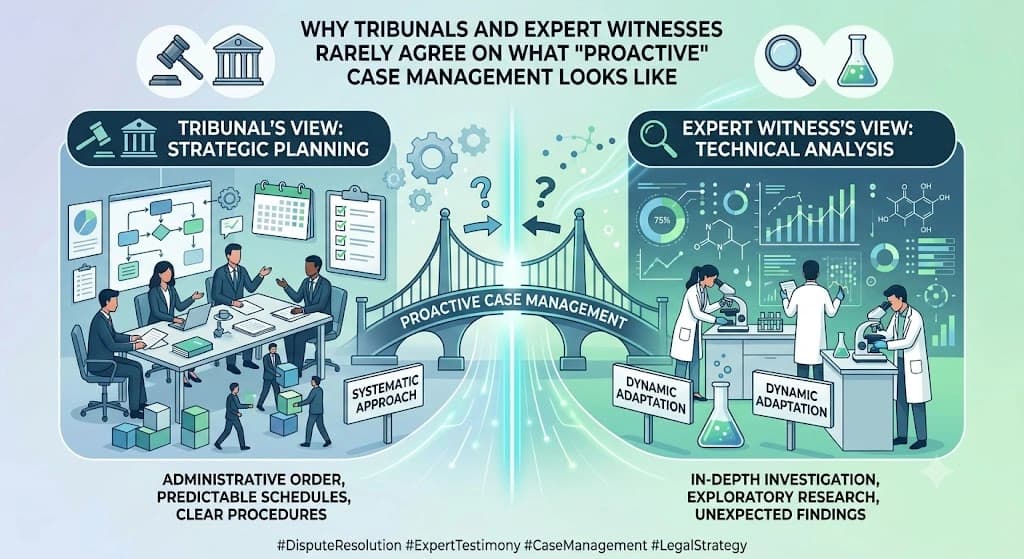

Two experts, each highly qualified, look at the same set of facts and reach different conclusions about what being an expert witness actually requires of them. One assumes the job is to build the most rigorously defensible analysis for the party that retained them, fully expecting it to be tested by an opposing expert and by pointed cross-examination. The other assumes the job is to answer a defined set of questions as a broadly neutral technical resource for the decision-maker, largely insulated from party control from the moment of appointment. Neither expert is behaving unprofessionally. They are simply operating inside two different procedural traditions that have built almost opposite assumptions about where expert evidence comes from and how it should be tested.
This matters more than it might first appear, because international disputes routinely mix practitioners trained in one tradition with procedures shaped by the other, and the resulting friction rarely announces itself clearly. It shows up instead as vague discomfort, an expert who feels oddly constrained by a tribunal's approach, or counsel who cannot understand why opposing counsel is not pressing harder in cross-examination. Understanding the underlying structural difference explains most of this friction and makes it far easier to navigate.
The distinction also matters because the volume of genuinely cross-border technical disputes keeps growing, arbitration seated in one jurisdiction, applicable law from another, a tribunal drawn from a third, and parties and their experts from still others. Very few practitioners today can afford to assume their home jurisdiction's approach to expert evidence is simply how expert evidence works everywhere. The practitioners who thrive in this environment are the ones who have internalized both traditions well enough to move fluidly between them, adjusting expectations and strategy to match whichever system actually governs a given proceeding.
Two Starting Assumptions About Where Expert Evidence Comes From
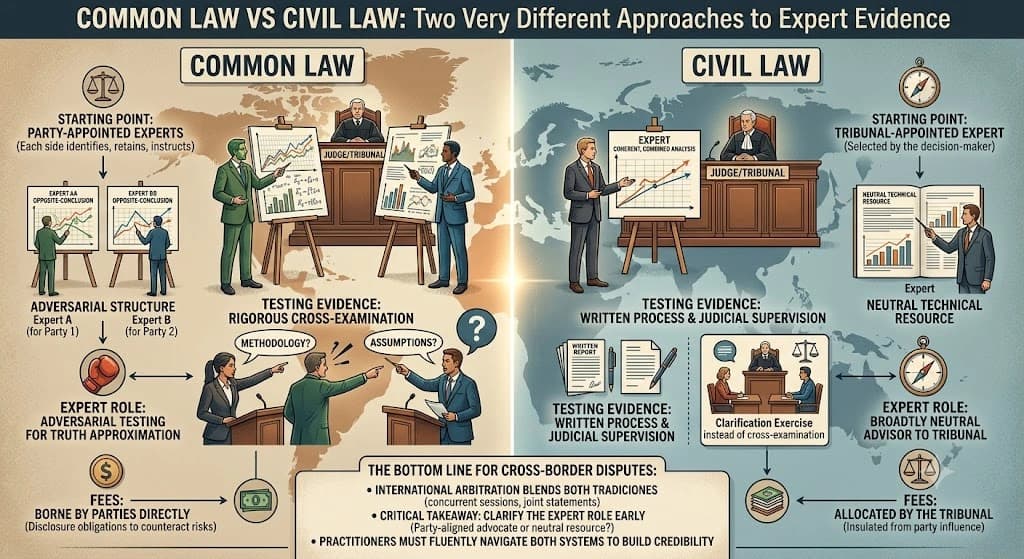
In common law systems, expert evidence traditionally begins with the parties. Each side identifies, retains, and instructs its own expert, who investigates the technical questions relevant to that party's case and produces an opinion accordingly. The adversarial structure assumes that truth is best approximated by testing two competing, professionally prepared positions against each other, through cross-examination, through a decision-maker weighing which analysis holds up better under scrutiny. The expert's independence obligation exists precisely because this system depends on party-appointed experts behaving as something more than advocates, but the starting architecture is still fundamentally adversarial: two experts, two parties, two competing analyses.
In civil law systems, the more traditional starting point is different. Many civil law jurisdictions place greater weight on court-appointed or tribunal-appointed experts, selected by the decision-maker rather than the parties, given a defined mandate or set of questions to answer, and expected to report back as a broadly neutral technical resource serving the tribunal directly rather than either side. The inquisitorial tradition underlying this approach assumes that a neutral expert, insulated from party selection and instruction from the outset, produces evidence less vulnerable to the appearance or reality of advocacy, even if it sacrifices some of the adversarial testing that the common law model relies on.
Neither model is inherently superior, and describing them as pure types oversimplifies practice in both traditions, party-appointed experts appear in many civil law proceedings, and court-appointed experts are not unknown in common law systems. But the underlying default assumption, who selects the expert and on whose behalf the expert is understood to be working, differs enough between the two traditions to shape almost everything else about how expert evidence functions.
It is worth being precise about what does not change between the two systems, because the similarities are as important as the differences for a practitioner trying to navigate both. In both traditions, the expert is expected to bring genuine subject-matter expertise, to reason from evidence rather than from a predetermined conclusion, and to serve the decision-making process rather than any single participant's narrow interest. The disagreement between the two systems is about the best structural mechanism for securing that outcome, not about whether the outcome itself matters.
How Instruction and Appointment Differ in Practice
In the common law default, an expert is found, interviewed, and formally instructed by one party's counsel, working from a brief that describes the disputed questions from that party's perspective. The expert may have latitude to expand the scope of inquiry, but the starting mandate comes from one side of the dispute, and the expert's fees are paid by that side throughout the engagement. Disclosure obligations exist precisely because this starting arrangement creates the potential for one-sidedness that needs to be checked through transparency about instructions, assumptions, and methodology.
In the civil law default, an expert is more commonly appointed by the court or tribunal itself, sometimes from a list of approved specialists, sometimes through a process that allows the parties to comment on or object to a proposed appointee before confirmation. The expert receives formal terms of reference, questions framed by the decision-maker rather than by either party, and reports back through a process the tribunal directly supervises. Parties often retain their own technical advisors in this system too, but those advisors typically play a supporting role, helping counsel understand and respond to the court-appointed expert's findings, rather than producing a competing formal opinion with equivalent standing.
This difference in appointment shapes the entire texture of the resulting evidence. Party-appointed expert evidence tends to be more explicitly argumentative in structure, organized around supporting a particular conclusion with the strongest available reasoning. Court-appointed expert evidence tends to be more explicitly exploratory in structure, organized around answering the specific questions posed regardless of which party's position the answer happens to support.
Fees and cost allocation typically follow the same structural logic. In the common law default, each party bears the cost of its own expert directly, which is one reason cost-recoverability and proportionality of expert fees are recurring topics of debate in that tradition. In the civil law default, the cost of a court-appointed expert is more commonly allocated by the tribunal itself, sometimes shared upfront by the parties regardless of outcome, sometimes assigned as part of the final costs award, which shifts some of the financial incentive structure that shapes how aggressively either side pursues additional, party-retained technical advice.
How the Testing of Expert Evidence Differs
The common law tradition tests expert evidence primarily through cross-examination, an adversarial, often confrontational process in which opposing counsel probes methodology, assumptions, and conclusions in real time, in front of the decision-maker, with the explicit goal of exposing weaknesses. This process assumes that rigorous, skilled challenge is the most effective mechanism for revealing where an expert's analysis is strong and where it is vulnerable, and it places significant weight on an expert's composure and clarity under pressure as part of what makes their evidence credible.
The civil law tradition more commonly tests expert evidence through a written process: parties submit written questions or objections to a court-appointed expert's report, the expert responds in writing, and the process may or may not include a hearing where the expert answers further questions, often posed by the judge directly rather than by opposing counsel in an adversarial format. Where oral questioning does occur, it frequently looks less like cross-examination and more like a structured clarification exercise, with the decision-maker taking a more active role in framing the questions than counsel does.
International arbitration sits between these two traditions and has developed its own hybrid practices as a result. Party-appointed experts remain common even in arbitrations seated in civil law jurisdictions or involving civil law-trained arbitrators, but many tribunals have also adopted testing mechanisms, concurrent evidence sessions where opposing experts are questioned together, tribunal-posed questions submitted in advance of a hearing, that blend adversarial and inquisitorial elements deliberately, precisely because international tribunals routinely include arbitrators and counsel trained in both traditions and have had to develop procedures that work reasonably well for practitioners from either background.
This hybrid environment has also produced its own emerging norms around joint expert processes, requiring party-appointed experts to meet and produce a joint statement of agreement and disagreement before a hearing, that borrow the adversarial system's reliance on party-selected experts while importing some of the inquisitorial tradition's emphasis on narrowing issues collaboratively before testimony rather than leaving that narrowing entirely to cross-examination. Arbitral practice in this sense functions less as a compromise between the two traditions and more as a genuinely third approach, drawing deliberately on the strongest features of both.
Why This Distinction Matters for Practitioners Working Across Borders
An expert trained exclusively in a common law adversarial tradition, appointed for the first time as a tribunal-appointed expert in a civil law-influenced proceeding, can misjudge the role significantly if they approach it the way they would approach a party engagement. Overly advocacy-oriented framing, treating the tribunal's questions as an opportunity to build the strongest case for one party rather than answering as a neutral resource, undermines the entire premise of the appointment and can seriously damage the expert's credibility in a system built around trusting that a court-appointed expert has no side to advocate for.
Conversely, an expert or counsel more accustomed to the civil law tradition can be caught off guard by the intensity and adversarial framing of cross-examination in a common law-influenced proceeding, mistaking pointed, skeptical questioning for a personal or unusually hostile challenge rather than recognizing it as the system's standard mechanism for testing evidence. Experts unfamiliar with this style sometimes respond defensively in ways that read poorly to decision-makers accustomed to composed, confident performance under cross-examination as itself a signal of credibility.
Counsel navigating cross-border disputes face a parallel challenge in choosing how to approach expert evidence in the first place. Counsel trained primarily in an adversarial tradition, appearing before a tribunal with civil law-influenced members, may under-appreciate how much more weight those decision-makers place on a court-appointed or jointly-agreed expert relative to competing party-appointed experts, and may need to adjust strategy accordingly, investing more heavily in constructive engagement with a neutral expert process rather than assuming an adversarial battle of competing opinions will carry the same weight it would in a purely common law forum.
Common Pitfalls When Practitioners Assume One System Applies Universally
The most frequent pitfall is treating disclosure and independence obligations as interchangeable across systems when they are not. Common law disclosure rules, requiring an expert to reveal instructions, assumptions, and any drafts exchanged with counsel, developed specifically to counteract the risks inherent in party appointment and instruction. Applying the same expectations rigidly to a court-appointed expert in a civil law-influenced system, where the underlying appointment structure already provides a different kind of insulation from party influence, can create confusion about what transparency is actually required and why.
A second common pitfall is underestimating how differently "independence" gets demonstrated across the two traditions. In an adversarial system, independence is demonstrated partly through withstanding rigorous cross-examination without conceding ground the evidence does not support. In an inquisitorial system, independence is demonstrated partly through the appointment process itself, the fact of having been selected by the tribunal rather than a party, and partly through responsiveness to the tribunal's own follow-up questions rather than performance under adversarial challenge. An expert who tries to demonstrate independence using the wrong system's signals can inadvertently undermine the very credibility they are trying to build.
A third pitfall, particularly relevant in arbitration, is assuming that because a proceeding uses some party-appointed experts, it will therefore test that evidence exactly as a common law court would. Many tribunals blending both traditions expect a more collaborative, less overtly combative style of cross-examination than a domestic common law court might tolerate, and counsel who import an unmodified domestic cross-examination style into an international arbitration can find it lands poorly with arbitrators more accustomed to the civil law tradition's less adversarial questioning norms.
A fourth, more subtle pitfall involves written reports themselves. Experts trained in adversarial systems sometimes write reports that read, to a civil law-trained decision-maker, as more argumentative than the underlying analysis requires, front-loading persuasive framing in ways that can read as advocacy rather than neutral technical analysis. Conversely, experts trained in the inquisitorial tradition can produce reports that read, to a common law-trained decision-maker, as overly cautious or insufficiently decisive, when in fact that measured tone reflects the different expectations of the system the expert was trained in rather than any lack of confidence in the underlying conclusions.
What This Means in Practice
For experts accepting cross-border engagements, the practical takeaway is to clarify, explicitly and early, what kind of role is actually being requested: party-aligned advocate for a rigorously defensible position, or neutral technical resource answering a tribunal's defined questions. The two roles require genuinely different postures, and confusing them, in either direction, creates real credibility risk.
For counsel managing cross-border disputes, the takeaway is to research the composition and procedural background of the tribunal or court early enough to calibrate strategy accordingly, rather than defaulting to whichever approach to expert evidence is most familiar from domestic practice. A tribunal with a majority of civil law-trained members may respond very differently to an aggressive cross-examination strategy than a domestic common law jury would, and adjusting expectations in advance avoids a mismatch that only becomes apparent, expensively, at the hearing itself.
For institutions and tribunals managing genuinely mixed proceedings, the takeaway is that explicit procedural guidance on how expert evidence will be appointed and tested, set out clearly at the first case management conference, does more to prevent this kind of cross-tradition friction than leaving practitioners to guess which system's default assumptions will govern.
Frequently Asked Questions
Is one system, common law or civil law, generally considered better for expert evidence? Neither is straightforwardly superior. Each reflects a different, defensible theory about how truth is best approximated, adversarial testing versus neutral appointment, and each has genuine strengths and limitations that specialists in both traditions continue to debate.
Can a single arbitration use elements of both traditions? Yes, and this is increasingly common in international arbitration specifically, where party-appointed experts, tribunal-appointed experts, and hybrid testing mechanisms like concurrent evidence sessions can all appear within the same proceeding depending on what the tribunal and parties agree.
How should an expert prepare differently for cross-examination versus a civil law-style written questioning process? Cross-examination preparation should emphasize composure and clarity under real-time adversarial pressure, while written questioning preparation should emphasize precision and completeness in a response that will be read carefully without the same time pressure, but both ultimately reward the same underlying rigor.
Does independence mean something different depending on which system applies? The underlying principle, that the expert's analysis should not be shaped by which party is paying, is consistent across both traditions. How that independence gets demonstrated and tested, through adversarial challenge or through the appointment process itself, differs significantly.
What is the simplest way for an expert or counsel to prepare for a proceeding with an unfamiliar procedural tradition? Ask directly and early, of instructing counsel or the tribunal's procedural staff, exactly how expert evidence will be appointed and tested in this specific proceeding, rather than assuming the answer based on the seat of arbitration, the applicable law, or prior domestic experience alone. Procedural orders and terms of reference usually spell this out clearly once someone asks.
Conclusion
The common law and civil law traditions did not arrive at different approaches to expert evidence by accident. Each reflects a coherent theory about how a decision-maker can best trust technical evidence it is not equipped to evaluate independently, one betting on adversarial testing, the other on neutral appointment. Practitioners who understand both traditions, rather than assuming their home system's defaults apply universally, are far better positioned to navigate the cross-border disputes that increasingly define modern legal and arbitration practice, and far less likely to mistake a difference in procedural tradition for a difference in professionalism or competence. As international arbitration continues to blend elements of both systems into its own emerging norms, that fluency stops being a specialist skill reserved for cross-border practitioners and starts becoming a baseline expectation for anyone working seriously in technical dispute resolution.
Key Takeaways
● Common law systems default to party-appointed, adversarial expert evidence tested through cross-examination; civil law systems more commonly default to tribunal-appointed, neutral expert evidence tested through written questions and judicial supervision.
● International arbitration increasingly blends both traditions, using party-appointed experts alongside hybrid testing mechanisms like concurrent evidence sessions.
● Independence is a shared underlying principle across both systems, but how it is demonstrated, through withstanding cross-examination versus through the neutrality of the appointment process, differs significantly.
● Practitioners who apply one system's default assumptions about disclosure, testing, or independence rigidly to a proceeding governed by the other risk real credibility damage, even when acting in complete good faith.
Position yourself where the legal industry looks for expertise - sign up on exlitem.com to get discovered by leading lawyers and high-value clients.