
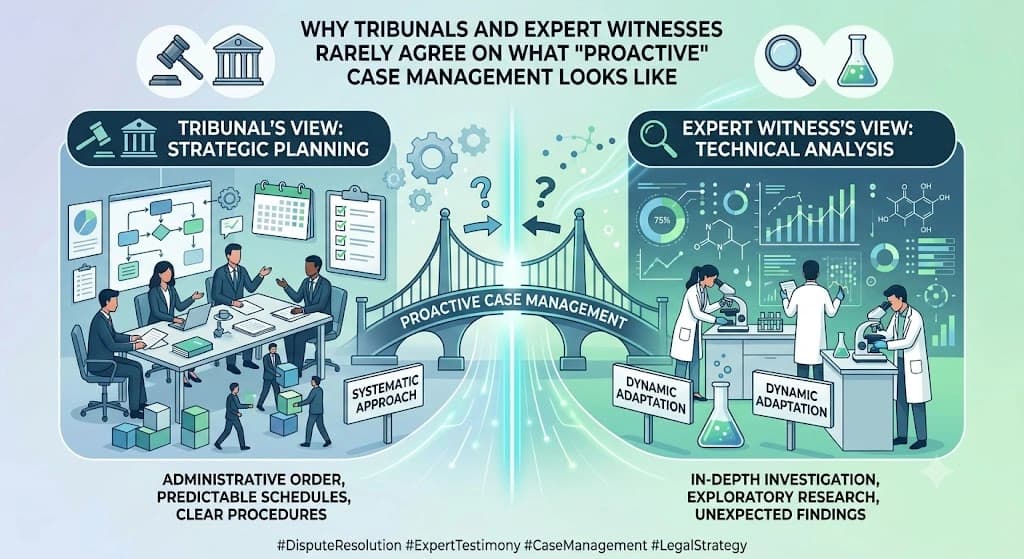
Every tribunal member managing a technical dispute believes they are being reasonably proactive about the expert evidence process. Ask the experts and counsel appearing in front of that same tribunal, and a striking number will describe the opposite experience: vague procedural orders, minimal engagement with expert issues until problems have already hardened, and directions that read as thorough on paper but leave the actual mechanics of expert evidence entirely to the parties to work out. Both groups are describing the same case management process. Neither is exactly wrong. They are simply measuring "proactive" against completely different baselines, and the gap between those baselines is quietly expensive.
This is not a story about incompetence on either side. Tribunal members are, almost without exception, conscientious about case management, and experts and counsel are not being unreasonable when they describe feeling under-directed. The disagreement survives contact with good faith on both sides because it is structural rather than personal, rooted in two genuinely different mental models of what "managing the expert process" is supposed to mean.
What makes the gap worth naming explicitly, rather than treating as an unavoidable feature of dispute resolution, is that it is closable at relatively low cost once both sides understand what the other actually means by proactive. Most of the friction described in this piece does not stem from an irreconcilable disagreement about how cases should be run. It stems from each side assuming the other shares its definition of a word they use constantly and rarely define.
Two Different Definitions of "Proactive"
From the bench, proactive case management typically means the existence of a clear procedural framework: a timetable with dates for report exchange, a sequence for questions, provision for a joint statement, and directions that anticipate the standard stages a technical dispute moves through. Measured against the alternative, a case with no such framework, left to drift until the parties themselves force a decision, this genuinely is proactive. A tribunal that has issued detailed procedural directions at the first case management conference has done meaningfully more than one that has not.
From the perspective of experts and the counsel instructing them, proactive means something narrower and more substantive: active engagement with the actual content of the technical dispute, not just its procedural shape. It means a tribunal that has identified, even provisionally, which technical issues are genuinely contested and which are not. It means directions tailored to the specific complexity of the dispute rather than a template borrowed from the last several matters. It means, in the more ambitious version, a tribunal willing to pose early questions to the experts once initial reports are filed, rather than waiting until a hearing to engage with the substance for the first time.
The first definition is procedural. The second is substantive. A tribunal can fully satisfy the first without coming close to satisfying the second, and most of the disagreement in this space stems from tribunal members genuinely believing that satisfying the first constitutes proactive management, while experts and counsel experience the absence of the second as its own form of drift, just drift wearing a well-organized procedural calendar.
This distinction also explains why the same tribunal can be praised by one case team as excellent at managing experts and criticized by another as passive, sometimes within the same sitting term. The variable is rarely the tribunal's actual conduct, which is often fairly consistent across matters. It is how closely each case's technical complexity happened to align with what the tribunal's standard procedural approach was built to handle.
Why the Gap Exists
The most obvious explanation, and a real one, is bandwidth. A tribunal or judge managing a full docket of technical disputes across different subject matters cannot engage with the substance of every case at the depth an expert steeped in a single matter for months would consider adequate. Issuing a solid procedural framework and trusting the parties to raise substantive issues as they arise is not laziness, it is often the only realistic way to manage a caseload responsibly.
A second, less discussed explanation is a genuine and defensible reluctance to appear to be directing the substance of the evidence. Tribunals are understandably cautious about engaging too actively with technical questions before the parties have fully presented their positions, out of concern that doing so risks the appearance, or the reality, of prejudging an issue that is meant to be tested through the adversarial process rather than shaped by the decision-maker in advance. This caution is not misplaced. But it produces a case management style that reads, from the expert's side, as passive precisely where more active engagement would have been genuinely helpful rather than prejudicial.
A third explanation is procedural habit. Standard directions get reused across cases because they work reasonably well most of the time and because drafting bespoke procedural orders for every matter is a significant time investment few tribunals can justify for every case. The template approach is efficient, but it produces directions calibrated to an average dispute rather than the specific one in front of the tribunal, and technical disputes vary enormously in what they actually require from case management. A template built for a moderately complex contract dispute applied to a highly technical, multi-expert construction claim will look identical on paper while functioning very differently in practice.
A fourth, quieter explanation is that tribunal members and experts are, understandably, working from different information. A tribunal knows what has worked reasonably well across many previous cases with a similar procedural shape. An expert knows, in granular detail, exactly where the current case's technical issues are genuinely contested and where a slightly different procedural choice, an earlier question, a narrower issues list, would have saved real time and cost. Neither party is wrong about what they know. They are simply working from different vantage points on the same case.
A fifth factor, rarely discussed openly, is that raising the gap directly carries a mild social cost for the party doing the raising. Counsel who suggests to a tribunal that its directions feel insufficiently tailored risks appearing presumptuous, particularly early in a case before any real rapport has developed. This quiet reluctance to name the gap explicitly is itself part of why the gap persists across so many disputes rather than being resolved case by case through ordinary conversation.
What "Proactive" Looks Like From the Bench
It is worth taking the tribunal's perspective seriously rather than treating it as a lower standard. From the bench, genuinely proactive case management includes issuing directions early enough that the parties have adequate time to comply, building in realistic sequencing for expert reports relative to fact evidence, anticipating likely points of procedural friction such as document production disputes that could delay expert access to underlying data, and remaining available for case management conferences when genuine disputes about process arise mid-case rather than only at fixed intervals.
This is real management, and disputes that lack it suffer visibly: compressed timelines, sequencing errors that force experts to work with incomplete records, and procedural disputes that consume hearing time better spent on substance. Tribunals that do this well are doing something experts and counsel underappreciate, because the absence of these problems is invisible in a way that their presence is not.
What "Under-Directed" Feels Like From the Ground
From an expert's seat, the experience of under-direction usually shows up as a series of small, specific gaps rather than a single dramatic failure. Directions that set a filing date for reports but say nothing about the format or expected structure, leaving each expert to guess at what will actually be useful to the tribunal. A joint expert process that is required by the procedural order but left entirely undefined in terms of how it should run, how many sessions, what should be documented, whether counsel should be present. A general expectation that experts will "narrow the issues" without any tribunal-level indication of which issues currently look genuinely disputed versus merely asserted.
None of these gaps are dramatic individually. Each is the kind of thing a diligent case team can work around with enough effort. But collectively, they shift a meaningful amount of case management work from the tribunal onto the parties, who then have to guess at what the tribunal actually wants, often getting it wrong in ways that only surface at the hearing itself, when it is too late to correct efficiently.
Counsel experiences a parallel version of this gap. Procedural directions that look thorough on paper but require significant interpretation in practice generate genuine uncertainty about how much initiative counsel should take versus how much should be left for the tribunal to specify. Taking too much initiative risks overstepping; taking too little risks a case that drifts exactly as the tribunal's more passive posture allows it to. Counsel frequently end up erring toward caution, which reinforces the very passivity that created the uncertainty in the first place.
Why This Gap Matters
The practical cost of this perception gap is not abstract. Cases where the tribunal believes management is proactive but the parties experience it as under-directed tend to generate a specific, recognizable pattern: procedural disputes that surface late, expert evidence that ends up less comparable across parties because each side's expert worked from a differently interpreted set of open-ended directions, and hearing time consumed by clarifying process questions that earlier, more substantive engagement could have resolved in writing.
There is also a credibility cost that runs in an unexpected direction. Parties who experience a tribunal as under-directed do not typically conclude that the tribunal is deliberately hands-off. They more often conclude that the tribunal has not fully grasped the technical substance of the dispute, since a fuller grasp, in their view, would have naturally produced more substantively tailored directions. This is frequently an unfair inference, since the tribunal's restraint is often deliberate and principled rather than a symptom of limited understanding. But the inference gets drawn anyway, and it quietly erodes confidence in the process in a way that is difficult to correct once formed.
This matters beyond the individual case, because that eroded confidence tends to travel. Counsel who have experienced this gap in one matter arrive at the next case with lower expectations of tribunal engagement generally, which shapes how much initiative they take, how much they raise proactively, and how much they simply work around rather than address directly. A perception gap that might have been closed with a single clarifying conversation in the first case instead compounds quietly across a practitioner's broader experience of the process.
Closing the Gap: What Genuinely Proactive Case Management Requires
Closing this gap does not require tribunals to become more interventionist in a way that risks the legitimate concerns about prejudging technical issues. It requires a small number of specific, low-risk practices that satisfy the substantive definition of proactive without crossing into directing the outcome of the evidence itself.
Tailoring procedural directions to the specific technical complexity of the dispute, rather than defaulting to a standard template, is the single highest-leverage change available. This does not require deep technical mastery of the subject matter, only a brief conversation, often at the first case management conference, about what kind of expert evidence process this particular dispute is likely to need.
Defining the joint expert process with enough specificity that experts are not left guessing, how many sessions, what format, whether a joint statement with reasons for disagreement is expected, closes one of the most commonly cited gaps without requiring the tribunal to engage with the substance of any technical disagreement.
Building in an explicit, early opportunity for the tribunal to ask clarifying questions once initial reports are filed, even brief, procedural, non-prejudicial questions, signals substantive engagement without crossing into directing the outcome, and often surfaces genuine ambiguities in the record early enough to resolve them efficiently.
None of these practices require a tribunal to depart from appropriate restraint on substantive questions. They require only slightly more specificity than a standard template typically provides, calibrated once, briefly, to the dispute actually in front of the tribunal rather than to the average case the template was built for.
What This Means for Tribunals, Counsel, and Experts
For tribunals, recognizing that procedural thoroughness and substantive engagement are experienced as different things by the parties is itself useful, because it reframes what "doing case management well" actually requires. A tribunal does not need to abandon appropriate caution about engaging with technical substance to close most of this gap; it needs to be more specific about process, in ways that cost relatively little time but meaningfully change how proactive the management is experienced to be.
For counsel, the implication is to raise process ambiguities early and explicitly rather than working around them quietly. A tribunal that has not specified how a joint expert process should run is often simply unaware that greater specificity would help, not resistant to providing it. Asking directly, at the appropriate procedural moment, closes a gap that silent workaround only perpetuates.
For experts, understanding this dynamic reframes what might otherwise feel like an adversarial or indifferent tribunal as, more often, a genuinely well-intentioned one working from a different definition of proactive than the one the expert is applying. This does not eliminate the practical difficulty of working within under-specified directions, but it does clarify where the useful intervention lies: not in assuming bad faith, but in prompting, through counsel, the specific clarifications that would close the gap.
For institutions and rule-makers overseeing dispute resolution more broadly, this gap suggests a modest but meaningful opportunity: model directions or optional checklists that tribunals can adapt case by case, reducing the reliance on generic templates without demanding that every tribunal draft bespoke procedural orders from first principles for every matter.
Frequently Asked Questions
Is this perception gap more common in certain types of disputes? It tends to be more pronounced in highly technical, multi-expert disputes, where the distance between a tribunal's general procedural competence and the case-specific technical detail is largest, and correspondingly smaller in more straightforward matters where standard directions genuinely fit the dispute well.
Should tribunals engage more with the substance of expert disagreements earlier in a case? Not necessarily in the sense of taking a substantive position, but there is real room for more specific, non-prejudicial procedural engagement, defining processes clearly and asking clarifying questions, without crossing into directing the outcome of the evidence.
Is it counsel's responsibility to raise these gaps, or should tribunals anticipate them? Realistically, both. Tribunals benefit from building more case-specific consideration into standard directions, and counsel benefit from raising ambiguities early rather than assuming a tribunal's silence reflects a deliberate choice not to engage.
Does this gap reflect a real difference in how much tribunals understand the technical issues? Not usually. The gap is more often a difference in procedural philosophy and caseload constraints than in technical comprehension, though it is frequently misread by parties as the latter.
What is the simplest first step for closing this gap in an ongoing case? Raising it directly and specifically, at a case management conference or in correspondence, asking the tribunal to clarify a particular process point rather than raising the gap as a general grievance, tends to be far more productive than either working around it silently or waiting for the tribunal to notice unprompted.
Conclusion
The disagreement over what proactive case management actually looks like persists not because either side is careless, but because the two groups are, in good faith, applying different definitions to the same word. Tribunals measure proactive against the presence of a clear procedural framework. Experts and counsel measure it against substantive engagement with the specific technical shape of their dispute. Closing that gap does not require either side to abandon a legitimate position. It requires naming the gap clearly enough that a small number of concrete, low-risk practices, tailored directions, clearly defined joint processes, early clarifying questions, can close most of the distance between what tribunals believe they are providing and what the parties actually experience.
Key Takeaways
● Tribunals and experts often use genuinely different definitions of "proactive" case management: procedural thoroughness on one side, substantive technical engagement on the other.
● The gap is structural, driven by caseload bandwidth, legitimate caution about prejudging technical issues, and reliance on standard procedural templates, not by carelessness on either side.
● Parties who experience a tribunal as under-directed often mistakenly infer limited technical understanding, when the real cause is usually procedural restraint or habit.
● A small number of low-risk practices, case-specific directions, clearly defined joint processes, and early clarifying questions, close most of this gap without requiring tribunals to engage substantively with disputed technical issues.
Position yourself where the legal industry looks for expertise - sign up on exlitem.com to get discovered by leading lawyers and high-value clients.