
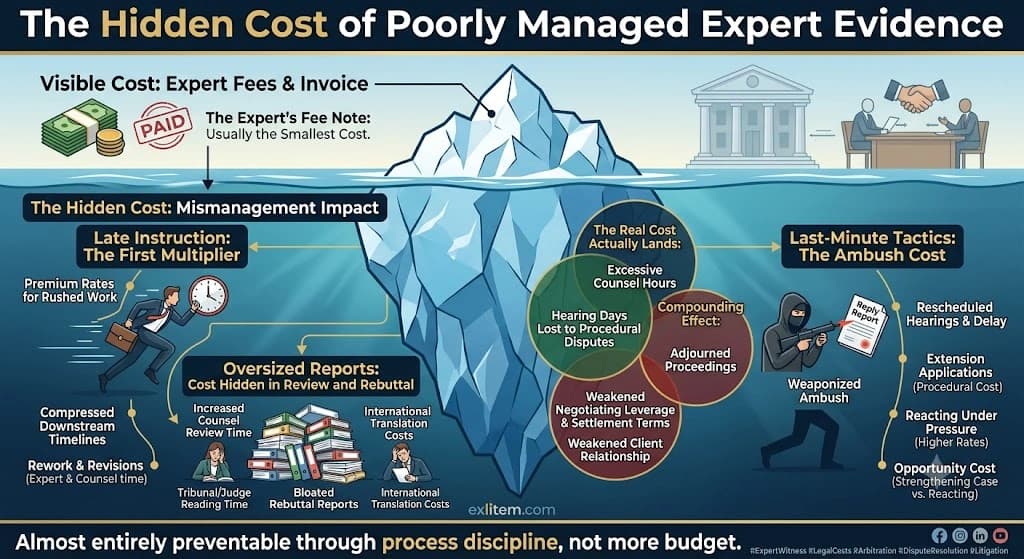
The expert's fee note is the easiest number in a case to point to and the least useful one for understanding what poorly managed expert evidence actually costs. Every dollar billed directly by the expert is visible, budgeted, and approved somewhere along the way. The real cost of mismanagement lives elsewhere: in the counsel hours spent untangling confusion the expert process itself created, in hearing days consumed by procedural disputes that never should have needed a hearing to resolve, in negotiating leverage quietly lost because a report nobody could parse failed to land with the decision-maker who mattered most.
None of this shows up as a single line item anywhere. It is scattered across legal fees, hearing costs, delay, and outcomes that are harder to value than a straightforward invoice, which is precisely why it survives so persistently across so many disputes. Nobody is deliberately choosing to spend this money. It accumulates as the downstream consequence of three specific, recognizable patterns, each avoidable, each compounding the others when left unaddressed.
What makes this cost particularly worth naming explicitly is that it is almost entirely preventable through process discipline rather than through spending more money. None of the fixes described later in this piece require a larger budget. They require earlier decisions, clearer expectations, and consistent follow-through on both, which makes the persistence of this hidden cost across the profession less a resourcing problem than an attention problem.
Why the Expert's Invoice Is the Wrong Place to Look
When a client or in-house team scrutinizes the cost of expert evidence, attention naturally goes to the expert's own fees, because that is the number that arrives as a discrete, itemized bill. But the expert's fee, even when it runs high, is usually a modest fraction of what poorly managed expert evidence actually costs a case. Every hour counsel spends interpreting an unclear report, every extension motion made necessary by a late-arriving opinion, every additional hearing day consumed by procedural wrangling over expert evidence, carries its own cost, usually a larger one, that never appears next to the expert's name on a budget summary.
This matters because it means the natural instinct, to control expert costs by negotiating the expert's rate or capping their hours, addresses the smallest and most visible piece of the problem while leaving the larger, hidden piece almost entirely untouched. A case team that successfully negotiates a lower expert fee while allowing late instruction, oversized reports, and last-minute tactics to persist unchecked has optimized the wrong variable.
This is a familiar pattern in cost management generally: the number that is easiest to measure gets the most scrutiny, regardless of whether it is the number that actually drives total spend. Expert fees are easy to measure because they arrive as a discrete invoice with a clear description attached. Counsel hours spent managing confusion, hearing days lost to procedural disputes, and settlement value eroded by a poorly received report are all real costs, but none arrive with the same clarity, so none receive the same scrutiny, even when their combined total dwarfs the expert's own bill.
Late Instruction: The First Multiplier
Late instruction inflates cost through more channels than the obvious one. The obvious channel is straightforward: compressed timelines require more hours worked in less time, often at premium rates, to produce the same analysis a longer runway would have allowed at a normal pace. This is real, but it is the smallest of the mechanisms at work.
The larger cost comes from rework. An expert instructed late frequently has to revisit and revise early analysis as gaps in the factual record surface mid-engagement, gaps that earlier instruction would have caught before the record hardened. Each round of revision costs money directly, in additional expert hours, and indirectly, in counsel time spent managing the revision process and explaining the resulting delay to a client who was told a report would be ready on a specific date.
There is a third, less obvious cost that compounds across a case with multiple experts. Late instruction of one expert in a sequenced, multi-expert dispute, a delay expert whose findings a quantum expert depends on, for instance, does not just delay that one expert's own work. It compresses every downstream expert's timeline simultaneously, multiplying the premium-rate, rushed-work cost described above across several experts rather than one, often without anyone tracking the aggregate effect until the final invoices arrive.
A fourth mechanism, subtler still, involves the opposing party's costs rather than the instructing party's own. Late-arriving expert evidence frequently forces the other side into a compressed response timeline as well, since procedural fairness generally requires giving the responding party adequate time once evidence is filed. A case team that instructs its own expert late is not only inflating its own hidden costs, it is often forcing a proportionate cost increase onto the opposing party's expert process too, which can factor into cost allocation disputes at the end of a case in ways that are easy to overlook when the late instruction decision was originally made.
Oversized Reports: Cost Hidden in Review and Rebuttal
A report that is significantly longer than the dispute actually requires imposes cost on everyone who has to engage with it, not just the expert who produced it. Counsel on both sides have to read, digest, and respond to the full document regardless of how much of it is genuinely load-bearing to the analysis. Opposing experts have to review and potentially rebut material that may be only tangentially relevant to the actual disputed issues, generating rebuttal reports that are themselves inflated in response, a dynamic that can spiral across successive rounds of exchange if nobody intervenes.
Tribunals and judges absorb this cost too, in the form of longer reading time before a hearing and, often, longer hearings themselves as counsel feels obligated to address material the report included even when it was never genuinely central to the dispute. A report padded with exhaustive background explanation, redundant restatement of undisputed facts, or excessive caveat language does not read as more rigorous to a time-constrained decision-maker. It reads as harder to extract the actual finding from, and that extraction cost gets paid, in time and attention, by every person who has to read it.
There is a compounding version of this cost specific to joint expert processes. Two oversized reports responding to each other across several rounds of exchange can turn a joint statement process, designed specifically to narrow the issues in dispute, into its own source of bloat, with each expert responding point by point to material in the other's report that was never central to begin with. What should function as an issue-narrowing exercise instead becomes an issue-multiplying one, and the cost of that inversion lands on everyone who has to review the resulting exchange before a hearing.
There is a translation and logistics cost specific to international disputes that is easy to overlook. A bloated report in a multi-language proceeding multiplies translation costs directly, and a report with poorly organized exhibits or inconsistent cross-referencing between narrative and appendices increases the time every reader spends simply navigating the document before they can even begin evaluating its substance.
Last-Minute Tactics: The Ambush Cost
Tactical delay, withholding a genuine point of disagreement until a reply report, raising a new methodology objection late enough that the other side has no realistic time to respond before a hearing, imposes cost through the disruption it forces onto an otherwise orderly process. An ambush reply report frequently triggers an application for an extension or a supplementary round of evidence, both of which consume hearing preparation time, generate additional procedural argument, and sometimes push a hearing date back entirely, with all the cost that a rescheduled hearing carries for every party and the tribunal itself.
Even when a late tactic does not succeed in derailing the schedule, the cost of responding to it under pressure is real. Counsel forced to prepare a rebuttal to a late-surfacing point in compressed time pays the same premium-rate, rushed-work cost described earlier in the context of late instruction, except now it is being paid reactively, in response to another party's tactical choice, rather than proactively as part of a case team's own planning.
There is also an opportunity cost worth naming specifically: hours spent managing a tactical ambush are hours not spent strengthening the substance of a party's own case. A legal team scrambling to respond to a late-surfacing methodology objection in the two weeks before a hearing is, by definition, not using that same time to sharpen its own expert's presentation, refine its own hearing strategy, or prepare more thoroughly for cross-examination. The tactic costs the targeted party twice, once in the direct work of responding, and again in the strategic work that response crowds out.
The reputational dimension of this cost is harder to quantify but genuinely real. A party or expert who develops a pattern of late-surfacing tactics across cases builds a track record that opposing counsel and tribunals both notice over time, and that track record tends to invite closer scrutiny, more skepticism, and less procedural goodwill in future matters, an indirect cost that outlasts any single case.
How These Three Patterns Compound Into Delay
Late instruction, oversized reports, and last-minute tactics do not operate independently. Late instruction increases the odds of an oversized report, because an expert working under time pressure often defaults to including everything rather than taking the additional time a genuinely disciplined edit requires. An oversized report increases the odds of a last-minute tactical dispute, because a document that is harder to parse creates more opportunities for a genuine disagreement, or a tactical one dressed up as one, to surface late rather than being identified and addressed early. And a last-minute tactic, once it succeeds in disrupting a schedule, frequently forces the next round of expert work into exactly the compressed timeline that produces late-instruction-style costs all over again.
This compounding is why the aggregate hidden cost of poorly managed expert evidence is rarely visible until a case is well underway, and often not fully visible until it concludes and someone finally adds up the actual legal spend against what was originally budgeted. Each individual instance of lateness, bloat, or tactical delay looks manageable in isolation. The cumulative effect across a full case rarely does.
Where This Cost Actually Lands
The most direct landing point is legal fees beyond the expert's own invoice: additional counsel hours spent managing confusion, drafting extension applications, and preparing rebuttals under time pressure. This is usually the largest single component of the hidden cost, and it is almost never tracked as a distinct line item tied back to expert evidence management, which is exactly why it goes unaddressed.
A second landing point is institutional and hearing cost, additional hearing days, adjourned proceedings, and the tribunal or court time consumed by procedural disputes that a better-managed expert process would never have generated. These costs are shared across all parties and, in many venues, factor into cost allocation decisions at the end of a case, meaning poor expert management by one party can end up affecting the other party's costs exposure as well.
A third, harder to quantify but genuinely significant landing point is settlement and negotiating leverage. A report that fails to land clearly with a decision-maker, because it arrived late, ran too long, or got tangled in a procedural dispute over tactics, weakens a party's negotiating position regardless of how sound the underlying technical analysis actually was. This cost never appears on an invoice. It shows up instead in a settlement reached on worse terms than the underlying merits would have supported, or in a hearing outcome that undersells analysis that was, on its own terms, genuinely strong.
A fourth landing point, easy to overlook because it extends beyond any single case, is the client relationship itself. A client who watches legal costs run well past the original budget, without a clear explanation tying the overage to specific, nameable causes, tends to lose confidence in the case team's cost management generally, even when the underlying legal work was excellent. Being able to point specifically to late instruction, report bloat, or opposing tactics as the identifiable drivers of a cost overrun protects that relationship in a way that a vague, unexplained overage never can.
What Proactive Cost Management of Expert Evidence Actually Looks Like
Managing this hidden cost effectively starts with treating the three patterns as a connected system rather than three separate problems to solve individually. Building a deliberate timing checkpoint into case strategy addresses late instruction directly and reduces the downstream pressure that produces oversized reports. Setting explicit expectations with the expert early about report length, structure, and a plain-language summary addresses bloat directly and reduces the surface area for late tactical disputes to exploit. And building genuine consequences, procedural or reputational, into how late tactics are handled discourages the pattern from repeating across future matters.
None of this requires new procedural rules or institutional reform. It requires case teams to recognize that the visible cost of expert evidence, the fee note everyone scrutinizes, is a small and often misleading fraction of the real number, and to manage accordingly.
It is also worth building a habit of naming the hidden cost explicitly to clients as a matter goes along, rather than only after it has materialized. A client told early that late instruction or an opposing party's tactical pattern is likely to inflate cost beyond the expert's own fee is far better positioned to understand a later overrun than one hearing about it for the first time in a final invoice. Transparency about this dynamic, in real time, does almost as much to protect the client relationship as preventing the cost in the first place.
Frequently Asked Questions
Is the hidden cost of poorly managed expert evidence ever quantifiable in advance? Not precisely, but case teams that have tracked it after the fact, comparing original budgets to actual legal spend on matters with significant expert evidence problems, consistently find the gap dominated by counsel hours and procedural cost rather than the expert's own fees.
Which of the three patterns, late instruction, oversized reports, or last-minute tactics, tends to be the most expensive? Late instruction is usually the most expensive because it is the pattern most likely to trigger the other two, but all three compound each other enough that isolating a single most costly pattern understates the real risk of allowing any of them to persist unaddressed.
Can capping the expert's fees meaningfully control the overall cost of expert evidence? Rarely on its own. Fee caps address the visible, smallest portion of the cost while doing little to prevent the larger, hidden costs generated by poor timing, report bloat, or tactical delay.
Does this hidden cost affect the party responsible for the mismanagement only, or does it spread? It frequently spreads. Hearing delays and additional procedural disputes consume time and cost for all parties and the tribunal, and cost allocation decisions at the end of a case do not always track cleanly back to which party's expert management created the underlying problem.
Should clients be told about this hidden cost before it materializes, or only if it becomes a problem? Explaining the risk early is almost always the better approach. Clients who understand in advance that late instruction or an opposing party's tactics could inflate costs beyond the expert's own fee tend to respond to an eventual overrun with far more confidence in the case team than clients encountering the explanation for the first time after the fact.
Conclusion
The true cost of poorly managed expert evidence rarely shows up where anyone is looking for it. It hides in counsel hours, hearing delays, and negotiating leverage lost to a report that never quite landed, scattered widely enough across a case that it is easy to miss until the final numbers are added up. Late instruction, oversized reports, and last-minute tactics are the three specific, recognizable mechanisms that generate this hidden cost, and they compound each other in ways that make addressing them individually far less effective than addressing them as a connected system from the outset. Case teams that understand this stop asking only what the expert's fee will be and start asking what poor management of that expert's evidence is likely to cost everywhere else.
Key Takeaways
● The expert's own fee is usually the smallest and most visible piece of the real cost of expert evidence; the larger cost hides in counsel hours, hearing delay, and lost negotiating leverage.
● Late instruction, oversized reports, and last-minute tactics are three distinct but mutually reinforcing patterns that compound each other across a case.
● Capping or negotiating the expert's fee rate addresses the smallest part of the problem while leaving the larger, hidden cost largely unaddressed.
● Managing this cost effectively requires treating timing, report discipline, and tactical conduct as a connected system rather than three separate issues.
Position yourself where the legal industry looks for expertise - sign up on exlitem.com to get discovered by leading lawyers and high-value clients.