
Most expert evidence does not fail because the expert was wrong. It fails for one of four entirely predictable, entirely avoidable reasons, and once you have watched a case go sideways from each of them a few times, they become almost boringly easy to spot in advance. The frustrating part is that none of these four failure points require bad luck, bad experts, or a genuinely difficult technical question. They require only that nobody was paying close enough attention to a specific, identifiable moment where things quietly went wrong.
This is a diagnostic framework, not a list of horror stories. Each failure point below shows up across disputes, jurisdictions, and technical disciplines in a recognizable pattern, and each has a fix that is neither expensive nor complicated, only deliberate. The value of naming them clearly is that a case team can check for each one before it becomes a problem rather than discovering it during cross-examination.
What makes this framework useful in practice is that all four failure points are observable well before a hearing, often well before a report is even filed, to anyone who knows to look for them. None require hindsight to identify. They require a case team willing to ask, at each stage of the engagement, whether the specific conditions that produce each failure are quietly present.
Failure Point One: Communication Breakdowns Between Expert and Counsel
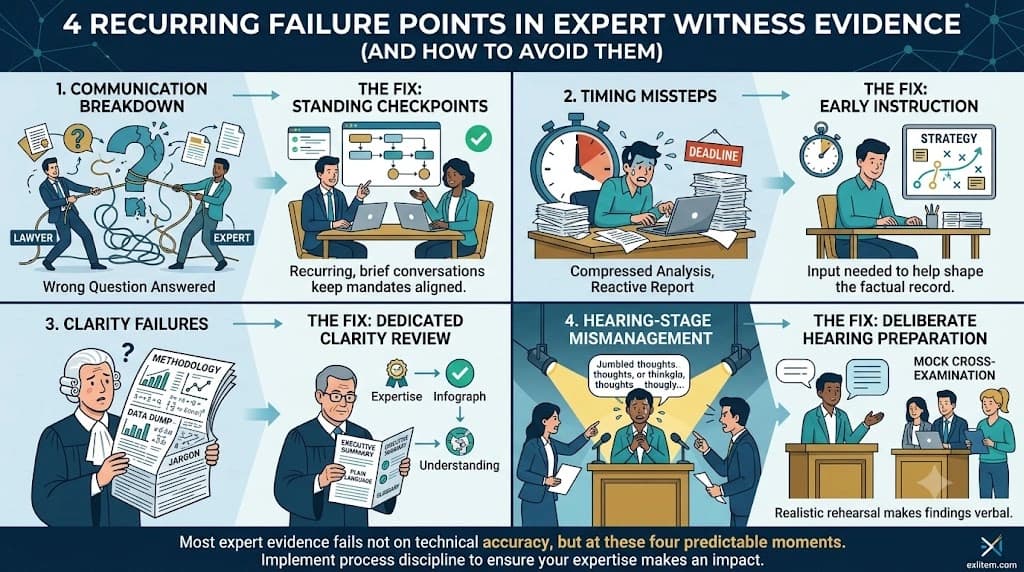
The first and most common failure point has nothing to do with technical competence. It is a communication gap between the expert and the legal team, usually invisible until a report is already drafted and it becomes clear the expert answered a different question than the one counsel actually needed answered.
This happens more often than the profession likes to admit, because instructions are frequently given once, early, and then left unrevisited as the case theory evolves. Counsel refines their argument over months of discovery and strategy discussions; the expert, working from an initial brief, keeps analyzing the original question. By the time the mismatch surfaces, often at a draft report review meeting far too close to the filing deadline, there is no time left to redo the analysis properly, only to patch the existing work around a theory it was never built to support.
The underlying cause is usually a false assumption on both sides: counsel assumes the expert will flag it if the brief becomes outdated, and the expert assumes that silence from counsel means the original brief still holds. Neither assumption is safe. Case theories shift, and experts, reasonably, keep executing the mandate they were given unless someone tells them otherwise.
The fix is a standing checkpoint rather than a one-time briefing. Scheduling a short, recurring conversation between expert and counsel, at meaningful intervals rather than only at the start and the end, closes this gap at almost no cost. The conversation does not need to be long. It needs to happen often enough that a shift in case theory reaches the expert before a full draft has already been built around the wrong question.
A less obvious variant of this failure point shows up in multi-expert cases, where several experts on the same side each communicate with counsel individually, but nobody is responsible for making sure their respective mandates remain consistent with one another as the case evolves. A quantum expert and a technical expert can each be perfectly aligned with counsel's instructions in isolation and still end up working from subtly inconsistent assumptions about the facts, simply because nobody was tasked with checking the two conversations against each other. Naming a single point of coordination, even informally, closes this version of the gap as effectively as the standing check-in closes the simpler one.
Failure Point Two: Timing Missteps
The second failure point is instructing the expert at the wrong point in the case, either too late to do the work properly or, less commonly, so early that the factual record the expert needs has not yet taken shape. Late instruction is the more frequent version, and its costs are well understood even if rarely acted upon: compressed analysis time, a factual record already shaped without technical input, and a report that reads as reactive rather than considered.
What is less discussed is how timing missteps interact with the other three failure points on this list. An expert brought in late has less time to build the kind of ongoing communication rhythm with counsel that fixes the first failure point. They have less time to draft, review, and simplify a report enough to avoid the clarity failures described next. And they walk into hearing preparation, the fourth failure point, with a compressed runway that makes rehearsal and refinement close to impossible. Timing is not just its own failure point, it is a force multiplier on the other three.
The fix here is less about any single tactic and more about building a deliberate checkpoint into case strategy: an explicit moment, early, where someone asks whether expert input is needed to help shape the factual record or only to interpret it once assembled. Teams that build this checkpoint into their process, rather than defaulting to instruction whenever a deadline forces the issue, consistently avoid the compounding effects described above.
It is worth naming the rationalization that usually accompanies late instruction, because recognizing it is half the fix. Late timing rarely gets defended directly; it gets explained after the fact as a reasonable response to case-specific circumstances, budget constraints, an evolving theory, an opposing party slow to disclose documents. Some of these explanations are genuinely valid in a given case. But when the same category of explanation recurs across most of a firm's matters, it stops describing case-specific circumstances and starts describing a default habit wearing the language of a one-off justification.
Failure Point Three: Clarity Failures in the Report Itself
The third failure point sits inside the report itself: analysis that may be technically sound but is written in a way that a non-specialist decision-maker cannot follow without significant effort. This is a genuinely common failure, and it is often invisible to the expert producing it, because technical language that reads as perfectly clear to another specialist can read as nearly impenetrable to a judge, arbitrator, or jury encountering the subject matter for the first time.
Clarity failures take a few recognizable forms. Reports that front-load dense methodology before ever stating the conclusion force a reader to hold a great deal of unexplained technical detail before understanding why any of it matters. Reports that use discipline-specific terminology without definition assume a shared vocabulary the decision-maker does not have. Reports that bury the single most important finding inside a long, undifferentiated narrative make it easy for that finding to get lost entirely, especially in a case with multiple experts and thousands of pages of submissions competing for the same attention.
None of this is a knock on rigor. A report can be exhaustively rigorous and still be clearly written; the two are not in tension, they simply require a different kind of editing discipline than most experts are trained in. The fix is treating clarity as a distinct deliverable from technical accuracy, worth its own dedicated review pass. A short executive summary stating the conclusion and its basis in plain language before the detailed analysis begins, a glossary of technical terms used more than once, and a genuine effort to have a non-specialist read the draft and flag anywhere they got lost, all meaningfully reduce this failure point at very low cost.
Clarity failures are not limited to prose. Poorly organized exhibits, inconsistent labeling between a report's narrative and its appendices, and visual aids that require a reader to flip back and forth between sections to follow a single argument all produce the same effect as dense writing: a decision-maker who cannot easily follow the reasoning discounts it, regardless of how sound that reasoning actually is. Treating structure and navigation as part of clarity, not just sentence-level writing, closes a gap that a purely prose-focused editing pass would miss entirely.
Failure Point Four: Hearing-Stage Mismanagement
The fourth failure point happens after the report is filed and the analysis is, in principle, already done: an expert who is technically excellent on paper but poorly prepared for how their evidence will actually be tested at a hearing. This includes being unprepared for the specific angle opposing counsel is likely to press on cross-examination, being unfamiliar with how to handle a hostile or leading question without becoming defensive, and being unpracticed at explaining complex findings verbally in real time, a very different skill from explaining them in writing with unlimited time to revise.
This failure point is particularly costly because it can undo months of otherwise excellent work in a matter of minutes. A tribunal or jury that watches an expert become flustered, evasive, or inconsistent under pressure will often discount even objectively strong written analysis, because the hearing performance becomes the more vivid, more recent impression the decision-maker carries into deliberation.
The fix is deliberate hearing preparation treated as a distinct phase of the engagement, not an afterthought squeezed in during the final week. This means realistic mock cross-examination, ideally conducted by someone other than the instructing counsel so the expert experiences genuine pressure rather than a friendly rehearsal. It means preparing the expert to state uncertainty plainly rather than overreaching for false precision under pressure, since overreaching is exactly what skilled cross-examination is designed to expose. And it means treating hearing preparation as beginning well before the hearing itself, ideally as soon as the report is finalized rather than in the days immediately preceding testimony.
A related risk worth preparing for specifically is the gap between an expert's written and oral answers on the same point. An expert who has not rehearsed explaining a nuanced finding verbally will often, under pressure, either oversimplify it in a way that sounds inconsistent with the written report or overcorrect into caveats so dense that the answer becomes unusable. Neither failure reflects a change in the underlying opinion, but both read, to a decision-maker watching in real time, as a credibility problem. Rehearsing the verbal version of the report's key findings, not just the ability to defend them, is a distinct skill worth its own preparation time.
Why These Four Failures Compound Each Other
None of these four failure points exists in isolation, and understanding how they interact matters as much as understanding each one individually. A communication breakdown between expert and counsel often surfaces late precisely because of a timing misstep that left no room for the standing check-ins that would have caught it earlier. A rushed report produced under timing pressure is far more likely to suffer clarity failures, because there was no time for the dedicated editing pass that clarity requires. And an expert working from a report that already has clarity problems walks into hearing preparation with a harder job, because they are now trying to defend, verbally and under pressure, findings that were not clearly reasoned on paper to begin with.
This compounding effect is why fixing these failure points individually, while useful, is less powerful than building a case process that addresses all four together from the outset. A case team that instructs experts early, maintains a standing communication rhythm, insists on a clarity-focused editing pass, and treats hearing preparation as its own dedicated phase has effectively inoculated itself against the most common ways expert evidence goes wrong, not through any single heroic intervention but through ordinary process discipline applied consistently.
The reverse is equally true, and worth stating plainly: a case team that lets one failure point slide because the case seems too small, too straightforward, or too budget-constrained to warrant the full process should expect the others to surface as a result, not as bad luck but as a fairly predictable consequence of how these four failure points feed each other.
What This Means for Legal Teams and Experts
For legal teams, the practical takeaway is that all four of these failure points are process failures, not talent failures, and process failures respond to process fixes. None of the fixes described here require exceptional experts or unusual resources. They require calendaring standing check-ins, building a timing checkpoint into early case strategy, budgeting for a dedicated clarity review, and scheduling real hearing preparation rather than assuming competence on paper will translate automatically to competence under cross-examination.
For experts, the takeaway is that technical excellence, while necessary, is not sufficient protection against any of these four failure points. An expert can be the strongest technical mind in their field and still lose credibility to a communication gap they did not create, a report that reads as impenetrable to the people who need to rely on it, or an unprepared moment on the stand. Building the habits that guard against each failure point, proactively raising a mismatch with counsel, requesting a clarity review, insisting on real mock cross-examination, is as much a part of professional expert witness practice as the underlying technical analysis itself.
For tribunals and decision-makers, understanding this framework has a quieter but genuine benefit: it offers a more accurate way to interpret why expert evidence sometimes underperforms relative to the underlying technical merit. A decision-maker who recognizes a clarity failure for what it is, rather than mistaking it for a weak underlying analysis, is better positioned to ask the clarifying questions that actually surface the substance. The same applies to hearing-stage struggles that stem from inexperience with cross-examination rather than from any real weakness in the written opinion. Separating process failures from substantive ones is as valuable a skill for a decision-maker as it is for the case team producing the evidence.
Frequently Asked Questions
Which of these four failure points is the most common? Communication breakdowns and timing missteps tend to be the most frequent, largely because they are the easiest to overlook until a deadline forces a reckoning, whereas clarity and hearing-stage problems are usually easier to spot once someone is specifically looking for them.
Can a single case suffer from more than one of these failure points at once? Yes, and it is common rather than unusual. Because the four failure points compound each other, a case with one unaddressed failure point often develops a second and third as a direct consequence, which is part of why addressing them individually is less effective than fixing the underlying process.
Is hearing-stage mismanagement really about the expert's public speaking ability? Not primarily. It is more often about the gap between explaining complex analysis in writing, with unlimited time to revise, and explaining it verbally under pressure and in real time. Confident public speakers can still struggle with this transition without dedicated preparation.
How much time should be budgeted for hearing preparation to meaningfully reduce this risk? There is no fixed rule, but preparation that begins only in the final week before a hearing rarely allows enough time for realistic mock cross-examination and genuine adjustment, which is the actual mechanism through which preparation reduces risk.
Do smaller or lower-value disputes still need to guard against all four failure points? Proportionality matters, and not every case can support the full version of each fix. But each fix scales down reasonably well: a brief standing check-in costs little, a clarity pass can be a single focused read-through, and even an hour of informal mock questioning meaningfully reduces hearing-stage risk compared to none at all.
Conclusion
None of these four failure points are exotic or difficult to understand once named, which is precisely what makes them so persistent. They do not require a genuinely hard technical question or an inexperienced expert to appear, only a case team that is not actively watching for them. The teams that consistently produce strong expert evidence are rarely the ones with access to unusually brilliant experts. They are the ones that have built ordinary, repeatable habits, standing communication, deliberate timing, dedicated clarity review, and real hearing preparation, that catch each of these four failure points before it has a chance to compound into the next.
Key Takeaways
● Most expert evidence fails for one of four predictable reasons: communication breakdowns, timing missteps, clarity failures, and hearing-stage mismanagement, not because the underlying analysis was wrong.
● These four failure points compound each other, so a case team that addresses only one in isolation often finds the others emerging anyway.
● Each failure point has a low-cost, non-exotic fix: standing check-ins, an early timing checkpoint, a dedicated clarity review, and genuine mock cross-examination.
● All four are process failures rather than talent failures, which means they respond reliably to deliberate process discipline.
Position yourself where the legal industry looks for expertise - sign up on exlitem.com to get discovered by leading lawyers and high-value clients.