
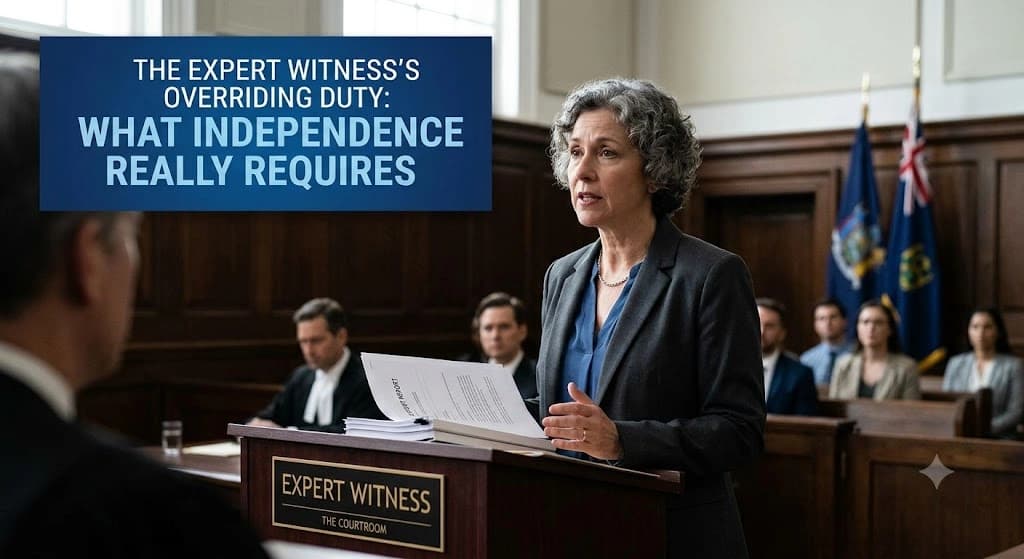
An expert witness is retained, briefed, and paid by one side of a dispute, and yet the entire value of that expert's opinion depends on behaving as though none of that were true. This is the strange contract at the center of expert evidence: the person writing the report has a commercial relationship with one party and a professional obligation to someone else entirely, the tribunal or court that will ultimately rely on the opinion. Everything about persuasive expert evidence traces back to how seriously that obligation is taken, by the expert, by the lawyers instructing them, and by the decision-maker judging the result.
Independence is the word used to describe this obligation, and it is also the word most likely to be misunderstood. Independence does not mean the expert has no opinion, no client, or no stake in being retained again. It means that whatever conclusion the expert reaches has to survive contact with an honest test: would this analysis look the same if the other side had asked the same questions of the same expert. Most expert evidence that gets discounted or excluded fails not because it was wrong, but because it could not plausibly pass that test.
What makes this obligation genuinely difficult, rather than simply a matter of good character, is that nothing about the commercial structure of the engagement reinforces it. Every ordinary incentive points the other way. Understanding independence well means understanding it as a discipline that has to be actively maintained against that pull, not a state that exists automatically for anyone with good intentions.
Whose Expert Is It, Really?
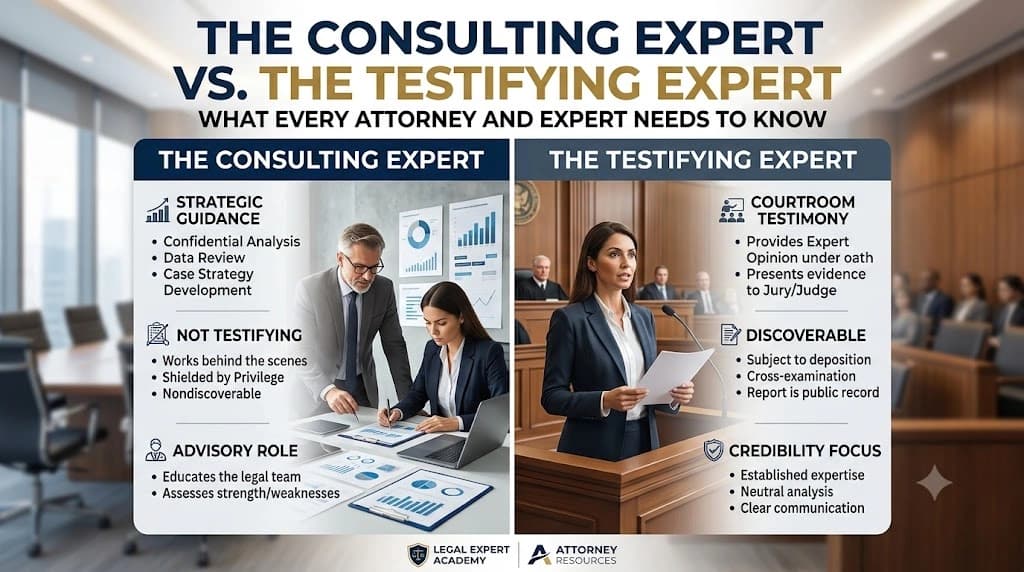
The starting confusion is structural. An expert is found, approached, briefed, and compensated by counsel acting for one party. Every incentive in that relationship, continued instructions, professional reputation within a legal community, plain collegiality, points toward alignment with the instructing side. Yet the overriding professional obligation runs the other way: toward the tribunal or court, not toward whoever is paying the invoice.
Most procedural frameworks governing expert evidence, whether in domestic litigation or international arbitration, articulate some version of this principle explicitly, precisely because it does not arise naturally from the underlying commercial relationship. Left unstated, the default gravitational pull of any professional engagement is toward the client. The overriding duty exists as a corrective, a formal reminder that the expert's obligations do not track the invoice.
This creates a genuine tension rather than a simple rule to follow. An expert who treats the instructing party's interests as irrelevant will struggle to get retained a second time, and reasonably so, since nobody wants to fund an engagement with no strategic value. An expert who treats those interests as paramount will produce evidence a tribunal correctly discounts as advocacy rather than analysis. The professional skill of expert witness work lives almost entirely in navigating that tension well, not in resolving it once and declaring victory.
What Independence Actually Requires
Independence is frequently described in terms of what it prohibits: no coaching, no result-oriented drafting, no suppressing inconvenient data. Those prohibitions matter, but describing independence only in negative terms misses what it actually demands affirmatively.
Independence requires that an expert's methodology, not just their conclusion, be something they would defend unchanged if the instructing party disappeared from the room. It requires being willing to tell counsel, at the outset or midway through an engagement, that the evidence points somewhere less favorable than hoped, and to say so clearly rather than softening the finding until it becomes ambiguous. It requires treating a request to "reconsider" an analysis as a request to test it again rigorously, not as a signal to find a different answer.
None of this means an expert must be indifferent to how their opinion lands. An expert can be genuinely persuaded that their client's position is correct and still be independent, so long as that conviction was arrived at through analysis rather than assigned as a starting condition. The test is not whether the expert's opinion happens to help one side. Most independent, rigorous analysis does help one side more than the other, because most disputes involve a position that is better supported by the evidence. The test is whether the opinion would have looked the same had the analysis been conducted with the same rigor but without a client attached to the outcome.
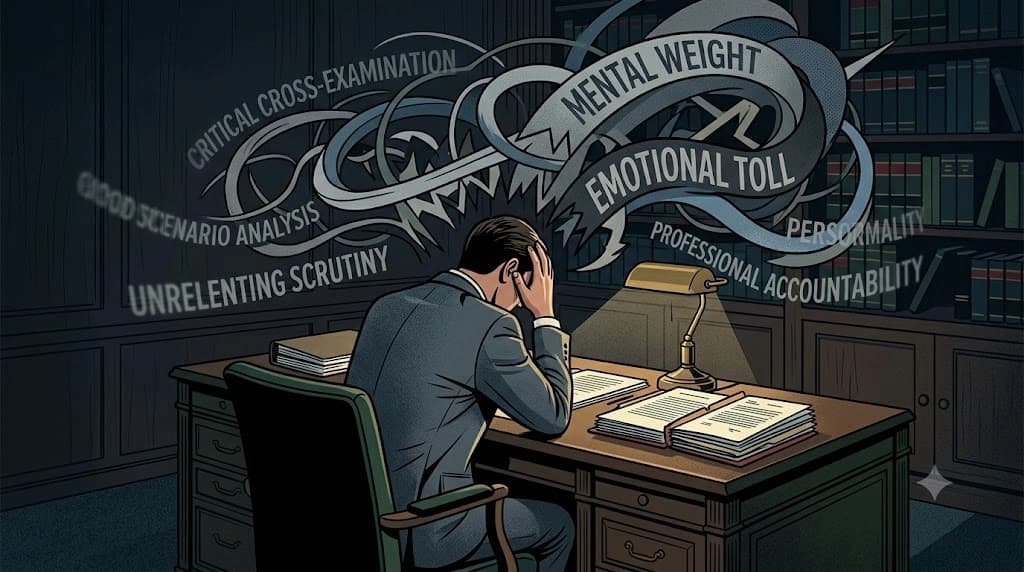
Independence also has to be maintained continuously rather than established once at the outset of an engagement. An expert can begin a case with a genuinely open, rigorous approach and still drift over months of engagement, as familiarity with the legal team, repeated conversations about strategy, and simple fatigue with defending an unpopular finding wear down the initial resolve. This is why the strongest experts tend to treat independence as something to actively re-check at each stage of a case, at the first draft, after a joint conference, before a hearing, rather than something settled permanently in the first meeting with counsel.
Independence Is Not the Same as Neutrality
A common and understandable confusion treats independence as a demand for neutrality, as if the ideal expert opinion should split the difference between both parties' positions. This gets the obligation backward. An expert's job is not to be neutral between two theories, it is to be rigorous in testing one specific set of technical or factual questions, wherever that rigor leads.
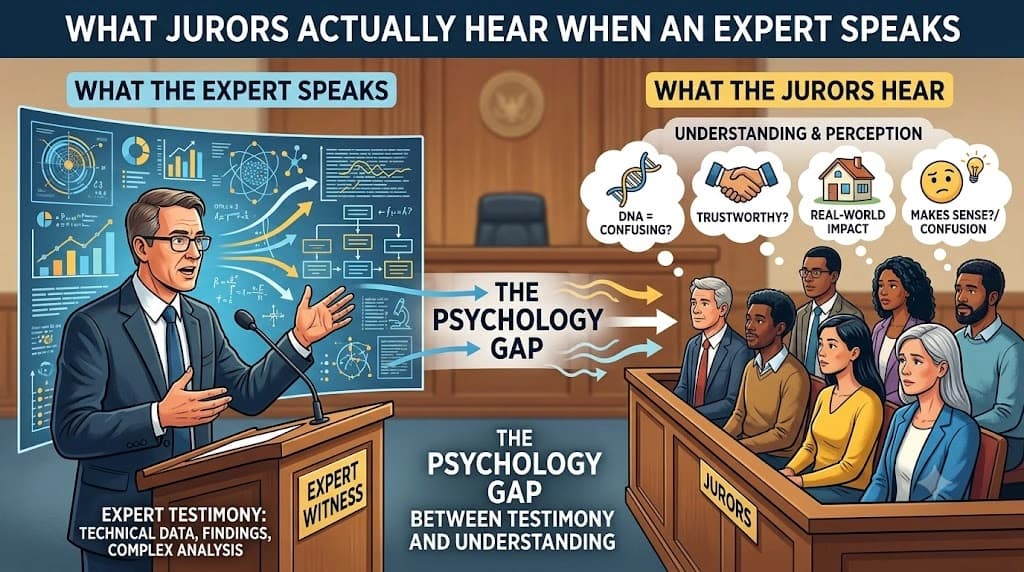
A genuinely independent expert can, and often should, reach a conclusion that strongly favors the instructing party, because the underlying facts frequently do favor one side more than the other on a given technical question. What makes that conclusion independent is not its proximity to the midpoint between the parties' positions, it is the visible, defensible reasoning connecting the evidence to the conclusion. A tribunal is not looking for balance for its own sake. It is looking for a chain of reasoning it can trust, and trust is earned through transparency about method, not through artificial equidistance from both sides' arguments.
This distinction matters practically because experts sometimes soften a strong, well-supported conclusion in the mistaken belief that appearing more moderate will read as more independent. The opposite is usually true. A decision-maker who can follow a clear, rigorously reasoned path to a strong conclusion trusts that expert more than one who hedges toward the middle without a methodological reason for doing so. Hedging without cause reads as either uncertainty or diplomacy, and neither builds credibility.
How Independence Gets Tested in Practice
Independence is rarely tested by a single dramatic moment. It is tested cumulatively, through a series of smaller decisions that either hold up under scrutiny or do not.
Cross-examination is the most visible test, and skilled counsel on the opposing side will probe precisely the seams where independence is most likely to have been compromised: whether alternative interpretations of the data were seriously considered and documented, whether assumptions handed down by instructing counsel were tested or simply accepted, whether the methodology would produce a different answer under slightly different but equally defensible inputs. An expert who has done the work honestly answers these questions comfortably, because the answers were arrived at independently in the first place. An expert who has not tends to reveal it through hesitation, inconsistency, or a retreat into vague generalities exactly where specificity is expected.
Joint expert processes, whether a joint statement, a meeting of experts, or concurrent evidence sessions, are another significant test, arguably a more revealing one than cross-examination itself. An independent expert engaging with an opposing expert's methodology can update, narrow, or sharpen their own position where the exchange genuinely warrants it. An expert whose opinion was shaped more by instruction than by independent analysis tends to resist any adjustment at all, because the position was never really theirs to revise, it was assigned, and revising it feels like conceding a point to the instructing party rather than responding to the evidence.
A third, quieter test happens well before any hearing: how an expert responds when counsel pushes back on a draft finding. An expert who can explain, calmly and with reference to evidence, why a particular conclusion stands despite counsel's discomfort with it has demonstrated the independence that matters most, because that conversation happens with no tribunal watching and nothing forcing the expert's hand except their own professional judgment. Experienced practitioners often describe this private moment, not the hearing itself, as the real test of whether independence is a genuine practice or a performance reserved for the record.
A fourth test, less common but increasingly used, comes from written questions posed directly by a tribunal or judge after an initial report is filed. These questions are often more revealing than cross-examination, precisely because they are not adversarial in tone and give an expert no obvious incentive to perform for one side. An expert who answers a tribunal's direct question with the same care and rigor shown in the original report, rather than treating it as an opportunity to reinforce the instructing party's case, is demonstrating independence in close to its purest form.
What Independence Costs When It Fails
The consequences of compromised independence rarely arrive as a single dramatic ruling. More often, they accumulate quietly and are only visible in hindsight. An opinion that shows signs of having been shaped by instruction tends to receive less weight than its technical content might otherwise deserve, not because the analysis was necessarily wrong, but because the decision-maker can no longer be confident it represents the expert's genuine, tested judgment rather than a conclusion reached to order.
There is a professional cost as well, one that extends well beyond a single case. An expert's value in this field is built entirely on a reputation for independence, and that reputation is fragile in a specific way: it can survive an unfavorable outcome on the merits, experts lose cases on close technical questions all the time without damage to their standing, but it struggles to survive a credible perception that the expert's analysis bent to instruction. Once a tribunal, or the broader professional community that talks about these things informally, forms that perception, it attaches to future engagements regardless of how rigorous the underlying work in those later cases actually is.
There is also a cost to the instructing party that is easy to underestimate in the moment. An expert whose independence has been visibly compromised does not just produce weaker evidence in the current dispute, they become a liability the legal team now has to manage around, explaining away in submissions, distancing from in oral argument, and hoping the decision-maker does not weight too heavily against the rest of the case. The short-term convenience of a more accommodating expert is rarely worth this longer-term cost, and experienced counsel increasingly recognize this even when the pressure to seek a friendlier opinion in the moment is real.
Where Assistance Ends and Advocacy Begins
The most difficult line in expert practice is not between independence and dishonesty, most experts are not remotely tempted to lie. It is between legitimate assistance to a legal team and a slow drift into advocacy that neither the expert nor counsel necessarily notices happening.
Legitimate assistance includes helping counsel understand which technical questions are actually disputed and which only appear to be, translating complex analysis into language a tribunal can follow, and flagging where a legal theory rests on a technical assumption the evidence does not support. All of this makes an expert more useful without compromising independence, because it is analytical and explanatory rather than results-driven.
The drift toward advocacy usually starts smaller: agreeing to emphasize a particular framing because counsel finds it more persuasive, agreeing to omit a caveat because it complicates the narrative, agreeing to answer a question more definitively than the underlying analysis actually supports because certainty reads better in a report. None of these individually feels like crossing a line. Collectively, they move an expert from analysis toward performance, and the shift is often invisible to the expert experiencing it, because each step felt like a reasonable accommodation rather than a compromise.
The practical marker worth holding onto is this: assistance shapes how an opinion is communicated, advocacy shapes what the opinion is. An expert who finds themselves adjusting substance rather than presentation in response to counsel's preferences has crossed from one into the other, whether or not anyone involved would describe it that way.
What This Means for Experts and the Legal Teams Instructing Them
For experts, the practical implication is to build independence into process rather than relying on intention alone. Documenting alternative interpretations considered and rejected, keeping a clear record of when and why a position changed during an engagement, and being willing to say plainly, early, that a finding may not favor the instructing party are all ways of making independence visible rather than simply asserted. Independence that only exists as a private mental commitment is much harder to defend under scrutiny than independence that shows up in the paper trail.
For legal teams, the implication is about the posture taken toward instruction. Counsel genuinely serves their own case better by treating an expert's early findings as information to be understood rather than a draft to be negotiated. A legal team that pushes back hard on inconvenient findings, again and again, teaches an expert, even an experienced and well-intentioned one, that certain conclusions are unwelcome, and that lesson shapes future analysis in ways that are difficult to detect and easy to deny. The legal teams that get the most value from expert evidence are usually the ones most disciplined about not doing this, and it is worth building that discipline into how instructions are given from the very first conversation, not just how draft findings are received later.
For tribunals and courts, the implication is that independence deserves active attention rather than assumption. An expert's credentials say nothing about whether independence held throughout a particular engagement. The signals worth watching for are the ones described above: how an expert responds to being pushed, how they engage with opposing analysis, and whether their reasoning would survive the instructing party's absence from the room.
Frequently Asked Questions
Can an expert be independent and still be genuinely persuaded their client's position is correct? Yes. Independence is about how the conclusion was reached, not whether it happens to favor the instructing party. Most rigorous, independent analysis supports one side more than the other, because the underlying facts usually do.
Does independence mean an expert should never discuss draft findings with instructing counsel? No. Discussing findings is normal and often useful. The concern is not the conversation itself but whether the conversation changes the substance of the analysis rather than how it is communicated.
How can a tribunal tell the difference between a confident, well-supported opinion and an advocacy-driven one? Primarily through the visibility of reasoning. An independent opinion shows its work, including the alternatives considered and rejected. An advocacy-driven opinion tends to assert a conclusion with less visible engagement with the evidence that complicates it.
What should an expert do if they realize, partway through an engagement, that earlier findings were shaped more by instruction than analysis? The most defensible path is to revisit the analysis honestly and update the opinion accordingly, documenting why, rather than proceeding with a conclusion the expert no longer has full confidence in.
Does losing independence always mean an expert acted in bad faith? No. Independence more often erodes gradually, through small accommodations that each felt reasonable at the time, than through any single deliberate decision to favor a client. Recognizing this is part of what makes active vigilance necessary rather than optional.
Conclusion
Independence is not a credential an expert earns once and carries forward. It is a discipline exercised repeatedly, in small decisions that rarely feel dramatic in the moment: which caveat to keep in, which alternative interpretation to document, how to answer counsel's pushback on an inconvenient finding. None of these decisions individually determines whether an expert's evidence holds up. Together, they are the entire difference between an opinion a tribunal trusts and one it quietly discounts. The experts who understand this treat independence as an ongoing practice rather than a box checked at the start of an engagement, and it shows, consistently, in the quality and durability of the evidence they produce.
Key Takeaways
● Independence is not neutrality. An expert can reach a conclusion that strongly favors the instructing party and still be fully independent, provided the reasoning would hold up without that party in the room.
● The overriding duty exists precisely because the natural pull of any paid engagement is toward the client, not because independence is the default outcome of good intentions alone.
● Independence is tested cumulatively, through cross-examination, joint expert processes, and private pushback from counsel, not through a single dramatic moment.
● The line between legitimate assistance and advocacy is the difference between shaping how an opinion is communicated and shaping what the opinion actually is.
Position yourself where the legal industry looks for expertise - sign up on exlitem.com to get discovered by leading lawyers and high-value clients.