
Where courts still touch arbitration
The 1996 Act was never meant to eliminate court involvement - only to confine it to defined points. Courts refer parties to arbitration under Section 8 when one side tries to litigate instead of arbitrating. They appoint arbitrators under Section 11 when the parties' own mechanism fails or is contested. They grant interim protection under Section 9, before or during proceedings. They hear challenges to an award under Section 34, and appeals from specified orders under Section 37. Foreign awards are enforced through Sections 47 to 49. Section 5 of the Act states the intent plainly: no judicial authority shall intervene except where the Act itself provides for it.
In practice, each of these entry points became, at different times, a wider door than the 1996 Act's drafters intended. Section 34 review, meant to permit only a narrow public-policy and patent-illegality check, was for years used by losing parties as a de facto second look at the merits. Section 9 interim-relief applications sometimes ran for years, effectively substituting for the arbitration they were meant to protect. Section 11 appointment applications frequently turned into extended hearings on whether a valid arbitration agreement existed at all, before an arbitrator had even been named. Each expansion added months, sometimes years, to disputes that were supposed to move faster than litigation, not merely relocate the delay.
Section 37 compounds the problem rather than resolving it. It allows an appeal from an order made under Section 34, and separately from certain orders refusing or granting interim relief, which means a losing party at the Section 34 stage often has one further round in a High Court, and sometimes a further special leave petition to the Supreme Court after that. A dispute that began as a private, single-tribunal process can, on this route, pass through as many as three or four layers of court scrutiny before it is finally over - precisely the outcome institutional arbitration and the last decade of reform have been trying to prevent.
A decade of narrowing
The correction has come on two tracks, legislative and judicial, moving in the same direction at different speeds.
On the legislative side, the Arbitration and Conciliation (Amendment) Act, 2015 was the first serious attempt to close the gaps. It inserted Section 11(6A), confining a court's role at the appointment stage to examining whether an arbitration agreement exists - nothing more. It introduced Section 29A, giving tribunals a twelve-month deadline, extendable by consent or court order, to render an award, addressing the open-ended timelines that had made ad hoc arbitration in India notoriously slow. The 2019 amendment went further, establishing the Arbitration Council of India to grade arbitral institutions and accredit arbitrators - an attempt to build the institutional infrastructure that would eventually let parties rely less on courts for administrative functions altogether. A 2021 amendment addressed a narrower but pointed problem, allowing courts to grant an unconditional stay on enforcement of an award where the underlying arbitration agreement or contract was induced by fraud or corruption, closing a route by which such awards could otherwise be enforced before the fraud allegation was resolved.
The judicial track has moved just as deliberately, if less predictably. In BALCO v. Kaiser Aluminium Technical Services (2012), a Constitution Bench fixed Indian arbitration law to a seat-centric framework, holding that Part I of the Act - the part that empowers Indian courts to intervene - does not apply to arbitrations seated outside India. That ruling, prospective in effect, closed off a long-running practice of Indian courts asserting jurisdiction over foreign-seated arbitrations simply because a contract had some Indian connection.
More recently, the Supreme Court has spent 2023 to 2025 methodically narrowing the scope of court review at nearly every remaining stage. In Cox and Kings Ltd. v. SAP India Pvt. Ltd. (December 2023), a five-judge Constitution Bench upheld the group of companies doctrine, allowing non-signatory affiliates to be bound by an arbitration agreement where the facts show a mutual intention to be bound - reducing the need for parallel court proceedings against group entities that would otherwise sit outside the arbitration. A seven-judge bench, ruling the same year on the interplay between arbitration agreements and the Indian Stamp Act, closed off another route through which courts had been drawn into referral-stage disputes: it held that an unstamped or insufficiently stamped agreement is not rendered void and does not stop a tribunal from being constituted, reversing an earlier position that had briefly required courts to rule on stamping before an arbitration could even begin.
In SBI General Insurance Co. Ltd. v. Krish Spinning (2024) and a string of decisions since, the Supreme Court has reaffirmed that a court examining a Section 11 appointment application is confined to a prima facie check on the existence of the arbitration agreement - questions of limitation, res judicata, or the merits of the underlying dispute belong to the tribunal, not the referring court. Once an arbitrator is appointed, the court that heard the Section 11 application becomes functus officio and cannot issue further directions, a point the Court has repeated to stop parties from returning to the same court for relief that Section 5's bar on judicial intervention was designed to prevent.
Two rulings from the last two years stand out for reshaping how appointment and post-award review actually work in practice. In Central Organisation for Railway Electrification v. ECI-SPIC-SMO-MCML (JV) (November 2024), a five-judge bench held that arbitration clauses allowing one party to unilaterally appoint the sole arbitrator, or to force the other side to choose from a panel that party alone curated, are not valid - even in government and public-sector contracts, a category in which such clauses had been standard for decades. The ruling applies prospectively, but it invalidates a drafting practice built into a large share of India's public procurement contracts, and pushes parties toward neutral appointment mechanisms of exactly the kind arbitral institutions are built to administer.
In Gayatri Balasamy v. ISG Novasoft Technologies Ltd. (April 2025), a five-judge bench ruled 4:1 that courts hearing a Section 34 challenge have a limited power to modify an arbitral award - confined to severing part of an award, correcting clerical or computational errors, adjusting post-award interest, and, for the Supreme Court itself, invoking its special powers under Article 142 of the Constitution sparingly. The dissent, from Justice K.V. Viswanathan, argued that reading in a modification power at all cuts against the 1996 Act's deliberate omission of the express modification power that the 1940 Act had granted courts, and against the Act's core design of minimal judicial interference. The disagreement is not a footnote. It marks a live fault line in Indian arbitration law, between a Court willing to stretch its remedial powers to avoid sending a flawed award back for re-arbitration, and a reading of the statute that treats any such stretch as intervention by another name.
Why institutions matter to this story
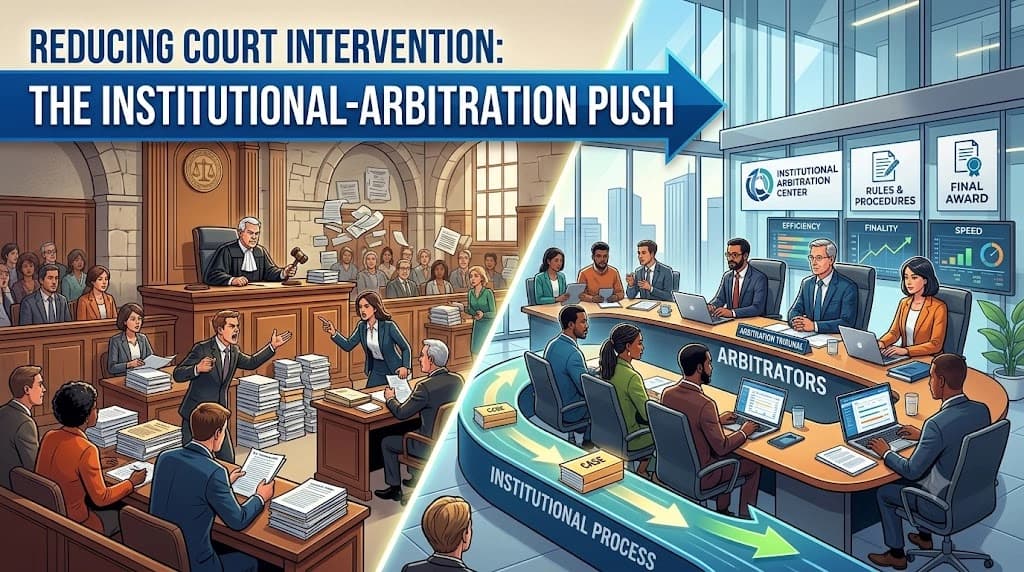
Legislative and judicial reform can narrow what a court is allowed to do. On their own, they cannot reduce how often parties end up asking a court to do something in the first place. That is the gap institutional arbitration is built to close.
An arbitral institution administers the parts of a dispute that most often required court involvement under ad hoc arbitration. It appoints arbitrators from a vetted, published panel through a transparent process, which sidesteps the unilateral-appointment problem the Railway Electrification ruling now prohibits. It can extend or manage award timelines without a Section 29A court application. Many institutional rules now provide for emergency arbitrators who can grant interim relief within days, reducing reliance on Section 9 at the outset of a dispute. And institutional scrutiny of a draft award before it is issued reduces the drafting defects - inconsistent reasoning, uncosted claims, procedural irregularities - that often become the grounds for a Section 34 challenge later.
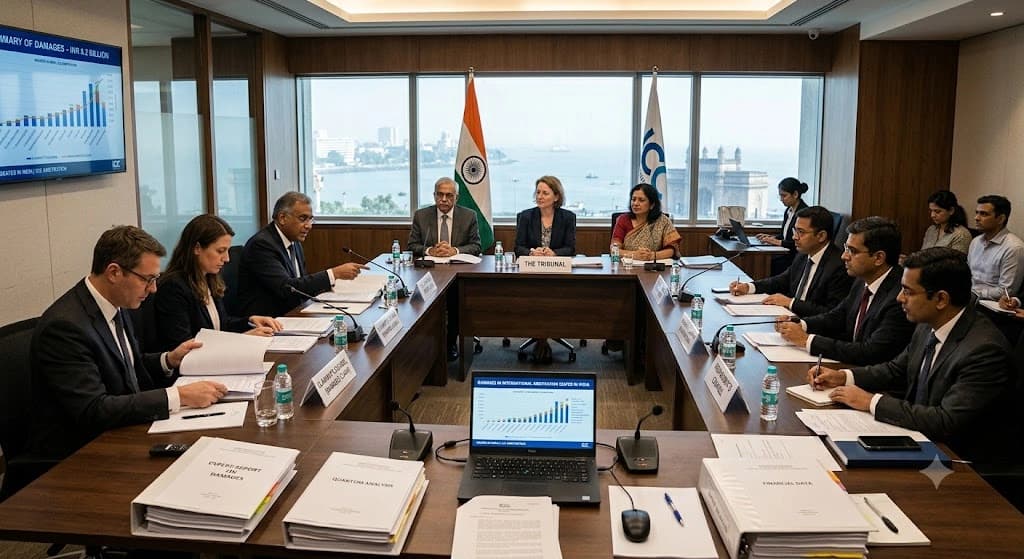
The growth is measurable, if still modest by the standards of Singapore, London or Hong Kong. The Mumbai Centre for International Arbitration recorded 34 new cases in 2024, up 48 per cent from 23 in 2023, with an aggregate dispute value of roughly USD 258 million, or about INR 2,180 crore, according to its own annual report. MCIA's 2025 Rules expanded from 36 to 49 provisions, adding mechanisms for multi-party proceedings and an expedited procedure for smaller-value claims. India has also built statutory institutional capacity alongside privately run centres: the India International Arbitration Centre in New Delhi was created by an Act of Parliament in 2019 and formally notified in 2022, replacing the erstwhile International Centre for Alternative Dispute Resolution and taking on a mandate to maintain panels of accredited arbitrators, provide arbitration infrastructure, and train arbitrators through its own academy. The arbitration centre in Hyderabad, established in 2021, has added further regional capacity outside the Mumbai-Delhi axis that historically dominated Indian institutional arbitration. And a proposed international arbitration centre at GIFT City's International Financial Services Centre - modelled on institutions such as the Singapore International Arbitration Centre and the London Court of International Arbitration, and structured as an independent not-for-profit company rather than a government body - is intended to give India a venue purpose-built for cross-border disputes, with a procedural framework designed from the outset to minimise recourse to domestic courts for arbitrations seated within the IFSC.
These numbers remain small relative to the volume of commercial disputes moving through Indian courts every year. But the direction is consistent: every case an institution administers from appointment through to award is a case with fewer natural points of contact with the court system than the same dispute would have had if run ad hoc.
The 2024 draft Bill: legislating the shift
The most direct attempt yet to write this shift into law is the draft Arbitration and Conciliation (Amendment) Bill, 2024, released for public consultation by the Department of Legal Affairs in October 2024, built on the recommendations of an expert committee led by former Union Law Secretary T.K. Viswanathan. Its stated objectives are explicit: incentivise institutional arbitration, reduce court intervention, and ensure arbitrations conclude on time.
The Bill's structure follows through on that framing. It proposes transferring several powers that currently sit with courts to arbitral institutions - the power to extend an award's time limit beyond the Section 29A deadline, to reduce an arbitrator's fees where delay is attributable to the tribunal, and to substitute an arbitrator. It proposes restricting a court's power to grant interim relief under Section 9 to only two windows - before arbitration commences, and after an award is made - leaving relief during the proceedings themselves to the tribunal under Section 17. It introduces a new Section 34A providing for appellate arbitral tribunals as an alternative to a Section 34 court challenge, letting parties opt into private appellate review instead of returning to court. It introduces a new Section 9A giving statutory recognition to emergency arbitrators and making their interim orders enforceable, closing a gap that had left emergency arbitration in something of a legal grey zone in India. And a proposed new Section 12A would place India's arbitral institutions under a formal regulatory framework of grading, accreditation and oversight - an unusual step by international standards, since most established arbitral institutions abroad are self-regulating.
As of this writing, the Bill has not been introduced in Parliament. It remains before the Department of Legal Affairs following the 2024 public consultation, and its final form - including whether the more contested proposals survive, particularly the Section 9 restriction, which would remove a safety net many practitioners currently rely on mid-arbitration - is still unsettled.
The gap between ambition and practice
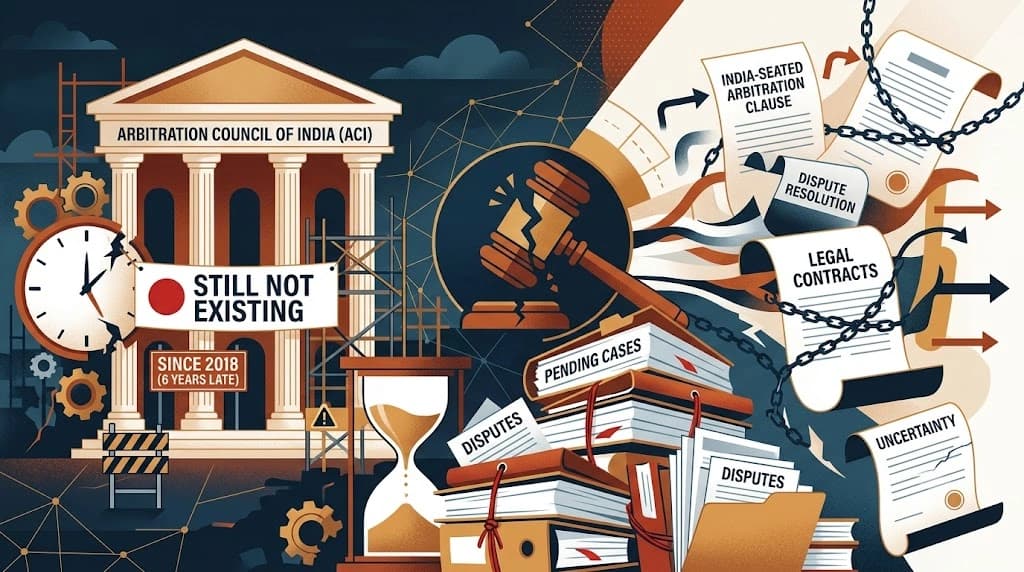
None of this closes the distance between the law on paper and how disputes are actually run. The Arbitration Council of India, created by the 2019 amendment specifically to grade institutions and accredit arbitrators, has taken years to become fully operational, which has slowed the kind of institutional standardisation the 2024 Bill now assumes is already in place. Government data on the pre-institution mediation process introduced under the Commercial Courts Act, 2015 - a parallel mechanism meant to keep disputes out of court before they start - show settlement rates in the low single digits, a sign that procedural nudges toward alternative dispute resolution do not, by themselves, change how parties and their counsel behave. And a meaningful share of Indian commercial contracts, particularly in infrastructure, public procurement and older financing documents, still contain ad hoc arbitration clauses drafted before the Railway Electrification ruling, the group of companies clarification, or the rise of institutional rules - clauses that will keep generating exactly the kind of court applications the last decade of reform has tried to eliminate, until they are renegotiated or expire.
What this means for how disputes should be drafted now
For attorneys advising on new contracts, the direction of travel is no longer ambiguous, even with the 2024 Bill still pending. Appointment clauses that give one party sole or panel-curated control over arbitrator selection are now a live risk after the Railway Electrification ruling and should be redrafted toward neutral, institution-administered appointment mechanisms. Seat and venue should be specified with precision and kept conceptually distinct, consistent with the BALCO line of authority, to avoid later disputes over which court holds supervisory jurisdiction. Institutional rules that provide for emergency arbitrators are worth building into high-value contracts now, ahead of Section 9A's uncertain legislative timeline, since several major Indian institutions already offer emergency relief mechanisms contractually, independent of the pending amendment. For cross-border contracts, the developing GIFT City IFSC arbitration centre is worth tracking, given its design intent to minimise domestic court touchpoints for India-connected international disputes.
For disputes already underway, the Railway Electrification and Gayatri Balasamy rulings both argue for reviewing existing appointment clauses and Section 34 strategy now, rather than after a challenge is filed. The prospective application of the Railway Electrification ruling in particular means the window for adjusting appointment practice on live contracts is closing, not open indefinitely - new appointments made under an old unilateral clause carry real risk of challenge, while appointments already completed before the ruling are generally shielded.
Takeaway
- Court intervention has narrowed, but the entry points remain. Legislative amendments in 2015, 2019 and 2021, together with a consistent run of Supreme Court rulings between 2023 and 2025, have steadily confined judicial review - but Sections 8, 9, 11, 34 and 37 still exist and are still used.
- Appointment clauses need re-checking. The Railway Electrification ruling (November 2024) makes unilateral and panel-curated arbitrator appointment clauses a live risk; contracts using them, especially in public procurement, should be reviewed before the next appointment is made.
- Institutional arbitration is the most reliable lever available today. Centres such as MCIA, the statutory India International Arbitration Centre, the Hyderabad arbitration centre, and the developing GIFT City IFSC arbitration centre remain small by global standards, but administered arbitration already reduces a dispute's exposure to court proceedings, well ahead of any legislative change.
- The 2024 Bill would go further, but its future is unsettled. Proposed restrictions on Section 9 relief, new appellate arbitral tribunals, and statutory recognition of emergency arbitrators are all still in draft form and have not been introduced in Parliament.
Position yourself where the legal industry looks for expertise - sign up on exlitem.com to get discovered by leading lawyers and high-value clients.