
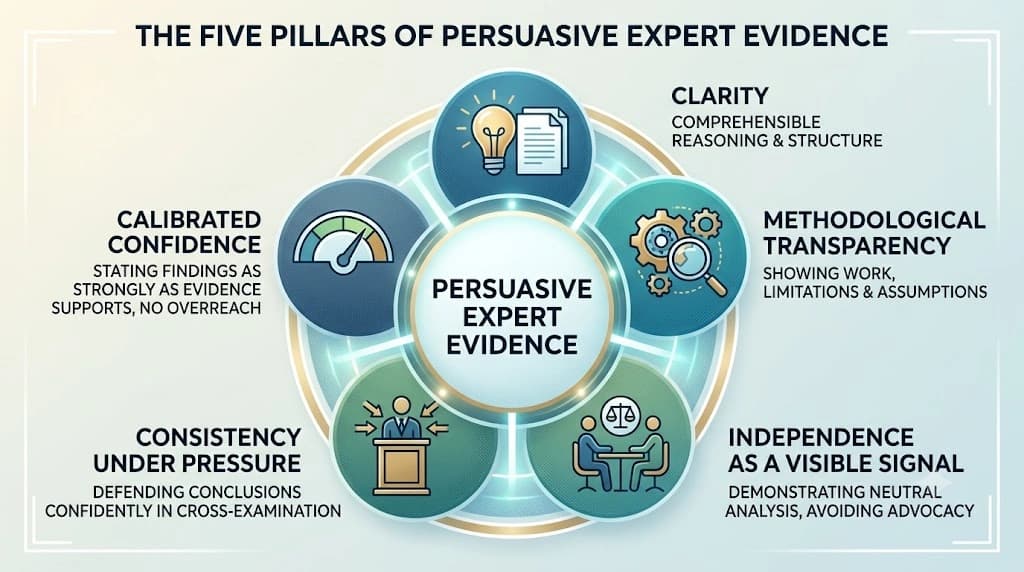
A tribunal member reads two competing expert reports on the same technical question and, often before finishing either one, has already formed a strong instinct about which one to trust. Ask that same tribunal member to explain the instinct in the moment, and the answer is usually vague: one report just felt more credible. That instinct is not arbitrary. It is the product of a handful of specific, identifiable qualities that separate expert evidence a decision-maker trusts from expert evidence they quietly discount, and naming those qualities clearly turns a vague sense of persuasiveness into something a case team can actually build toward, rather than something that either happens or does not.
None of these qualities are exotic, and none require an unusually gifted expert to produce. What they require is deliberate attention to a report and a witness's presentation, treated with the same rigor as the underlying technical analysis itself, because a decision-maker's trust in an opinion is earned through more than the correctness of its conclusion.
This distinction matters because it is genuinely uncomfortable for many experts to accept at first. Technical training rewards precision and correctness, and it is tempting to assume that sufficiently rigorous analysis should speak for itself regardless of how it is presented or defended. In practice, decision-makers are not simply grading technical accuracy against an answer key. They are making a trust judgment under real constraints, limited time, limited ability to independently verify specialist claims, and competing evidence pulling in different directions, and that trust judgment responds predictably to the qualities described below.
Clarity: Why Comprehensible Beats Comprehensive
The single most consistent driver of persuasiveness is whether a decision-maker can actually follow the reasoning without significant effort. This sounds obvious stated plainly, and yet a substantial share of expert evidence fails on exactly this point, not because the underlying analysis is wrong but because it is written for another specialist rather than for the judge, arbitrator, or jury who will actually decide the case.
Clarity is not the same as simplicity, and conflating the two leads experts to worry that writing clearly will make their analysis look less rigorous. The opposite is closer to the truth. A decision-maker who can follow a chain of reasoning easily trusts that reasoning more, because the absence of friction reads as confidence, an expert who understands their own analysis well enough to explain it plainly, rather than hiding uncertainty behind dense technical language. A report that states its conclusion early, explains the reasoning behind it in a logical sequence, and defines specialist terminology the first time it is used respects the decision-maker's time and attention in a way that a decision-maker notices, consciously or not, and rewards with greater trust.
The structural choices around clarity matter as much as the sentence-level writing. A report organized so the reader has to hold several unexplained variables in mind before understanding why any of them matter forces active decoding work that most decision-makers, however diligent, will not sustain evenly across a long document. Attention is a finite resource even for a conscientious tribunal member working through a demanding caseload, and a report that spends that attention efficiently, front-loading the conclusion and its basis before layering in supporting detail, gets a more careful, more favorably disposed read than one that saves the payoff for page thirty.
Methodological Transparency: Showing the Work, Not Just the Answer
The second major driver is whether an expert shows their work in a way that lets a decision-maker evaluate the reasoning independently, rather than simply asking them to accept a conclusion on the strength of the expert's credentials. This means describing not just the methodology used but why it was chosen over plausible alternatives, and being explicit about assumptions rather than burying them in a footnote or leaving them implicit.
Transparency about limitations is a particularly underused persuasive tool. Experts sometimes worry that acknowledging a limitation in the data or a genuine area of uncertainty will weaken their opinion, when the opposite is usually true. A decision-maker who sees an expert acknowledge a limitation plainly, and explain why it does not undermine the core conclusion, trusts that expert more than one whose report reads as though no limitation exists at all, because real technical analysis almost always has some. An opinion that claims artificial certainty invites skepticism the moment a decision-maker suspects, correctly, that the certainty is performed rather than genuine.
The same logic extends to how an expert handles data gaps specifically. An expert who explains what additional data would have strengthened the analysis, and why the available data was nonetheless sufficient to support the conclusion reached, gives a decision-maker a clear basis for trusting the judgment call involved. An expert who simply proceeds as though the available data were always complete and sufficient, without acknowledging the gap, leaves a decision-maker to either take that completeness on faith or discover the gap independently, neither of which favors the expert's credibility.
Showing alternative interpretations that were considered and rejected, and explaining why, serves the same function. It demonstrates that the conclusion survived genuine testing before it reached the page, rather than being the first plausible answer the expert happened to reach and then defended.
Independence as a Persuasive Signal, Not Just an Ethical One
Independence is usually discussed as an ethical obligation, which it is, but it is worth recognizing that independence also functions as a direct persuasive signal, separate from whatever the analysis actually concludes. A decision-maker reading a report has to make a judgment, often quickly and with limited ability to verify every technical claim independently, about how much to trust that the analysis was conducted honestly rather than constructed to support a predetermined position.
The signals that build this trust are specific and observable. An expert whose conclusion strongly favors the instructing party, but whose report shows visible evidence of having tested and rejected alternative interpretations before arriving there, reads as independent despite the favorable outcome, because the visible testing process is what independence actually looks like on the page. An expert whose report reads as a one-sided argument from the first paragraph, regardless of how technically sound the underlying analysis might be, invites the opposite inference, whether or not that inference is fair to the expert's actual process.
This is why independence and clarity reinforce each other rather than operating as separate qualities. A report that clearly shows its reasoning, including the parts that required genuine judgment calls, is inherently more persuasive on the independence dimension than one that simply asserts a conclusion, because visibility itself is what makes independence legible to a reader who cannot otherwise verify it directly.
Tone plays a quieter but real role in this signal as well. A report written in measured, analytical language tends to read as more independent than one written in overtly persuasive or advocacy-inflected language, even when the two reports reach identical conclusions from identical underlying analysis. Word choice that seems designed to persuade rather than to explain, however subtly, registers with an experienced decision-maker as a departure from the neutral, exploratory voice that independent analysis is expected to carry, and that registration happens well below the level of a decision-maker consciously cataloguing word choices.
Consistency Under Pressure: What Cross-Examination Actually Tests
Written persuasiveness only carries an expert so far if the same conclusions cannot be defended consistently under questioning. Decision-makers watching a witness under cross-examination or structured questioning are evaluating something the written report cannot fully convey: whether the expert's confidence in their own analysis holds up when it is tested in real time, under pressure, by someone actively looking for weaknesses.
This is less about performance skill than it might appear. An expert who has genuinely done rigorous, independent analysis tends to answer difficult questions comfortably, because the answers were arrived at honestly in the first place and do not require improvisation under pressure. An expert whose opinion was shaped more by instruction than independent judgment tends to reveal this through hesitation, inconsistency between written and spoken answers, or a retreat into vague generalities exactly where specificity is expected. Decision-makers, even those without deep technical expertise in the subject matter, are often remarkably good at detecting this difference, because the tell is less about technical content and more about the texture of how confidently and specifically an expert can defend their own reasoning.
Consistency also matters across the written record itself. An expert whose oral testimony subtly shifts the emphasis or framing of a written conclusion, even without technically contradicting it, creates a credibility gap that skilled opposing counsel will highlight directly, and that gap does real damage regardless of how minor the shift might seem to the expert making it.
Joint expert processes test this same quality in a different setting. An expert who engages substantively with an opposing expert's methodology during a joint conference, updating or sharpening their own position where the exchange genuinely warrants it, demonstrates the same underlying consistency of judgment that composed cross-examination testimony demonstrates. An expert who holds a position rigidly regardless of what the joint process surfaces raises the same credibility question in a quieter setting that an evasive answer under cross-examination raises in a more visible one.
The Quiet Killer: Overreach
Overreach, stating a conclusion with more certainty or precision than the underlying analysis actually supports, is one of the most persuasion-damaging habits in expert evidence, and one of the easiest to fall into without noticing. It often comes from a well-intentioned instinct: a decisive, confident answer feels more useful to the instructing party than a hedged one, and experts under time pressure or client pressure can drift toward overstating certainty without deliberately choosing to do so.
The damage overreach does is disproportionate to how it feels while writing the report. A single overreaching claim, once exposed under cross-examination as unsupported by the actual data, tends to cast doubt over an expert's entire opinion, not just the specific overreaching point, because a decision-maker who catches one instance of unsupported certainty reasonably wonders how many other claims in the report received the same treatment. This is why experienced experts often describe calibrated confidence, stating findings as strongly as the evidence genuinely supports and no more strongly than that, as a discipline worth actively defending against pressure to sound more decisive than the underlying analysis allows.
Overreach also has a specific, recognizable source worth naming directly: pressure, explicit or implicit, from the instructing legal team to make a finding more definitive than the expert's own analysis supports, because a more definitive finding is easier to argue from. This pressure rarely arrives as an explicit request to overstate a conclusion. It arrives as a request to reconsider softer language, to remove a caveat that complicates the narrative, or to state a range as a single figure. Experts who recognize this pattern early, and who can distinguish a legitimate request for clearer writing from a request that quietly shifts the substance, protect the calibrated confidence that makes their evidence persuasive in the first place.
How These Qualities Interact
None of these five qualities, clarity, methodological transparency, independence signaling, consistency under pressure, and calibrated confidence, function in isolation. A report that is transparent about its methodology but written too densely to follow loses much of the persuasive benefit of that transparency, because a decision-maker who cannot follow the reasoning cannot actually evaluate it, regardless of how honestly it was documented. An expert who writes a clear, well-reasoned report but then overreaches under cross-examination undermines the credibility that clarity built during the written phase.
This interaction is why persuasiveness is best understood as a system of mutually reinforcing habits rather than a checklist to complete once. An expert who builds all five qualities into how they work, not just into a single report, produces evidence that holds up consistently across the full arc of a case, from the first draft through cross-examination, rather than evidence that is strong on paper and fragile everywhere else.
The inverse pattern is worth naming too, because it explains why some technically excellent expert evidence still underperforms. An expert strong on independence and methodological rigor but weak on clarity produces evidence a decision-maker respects in principle but struggles to actually use, because using it requires more decoding effort than the decision-maker's time allows. An expert strong on clarity and presentation but weak on calibrated confidence produces evidence that reads well until cross-examination exposes the gap between how confidently something was stated and how well it was actually supported. Persuasiveness fails wherever the weakest of the five qualities sits, regardless of how strong the others are.
What This Means for Experts and the Counsel Preparing Them
For experts, the practical implication is to treat these qualities as deliberate craft rather than assuming they emerge automatically from strong technical analysis. Building a plain-language summary into every report, explicitly documenting alternatives considered and rejected, and rehearsing difficult questions before a hearing are all concrete practices that build persuasiveness systematically rather than hoping it appears on its own.
For counsel preparing an expert, the implication is to prioritize these qualities in review, not just technical accuracy. A review pass focused specifically on clarity, asking whether a non-specialist could follow the reasoning, and a review pass focused specifically on overreach, checking whether every strong claim is actually supported by the underlying data, catch problems that a purely technical review, focused only on whether the analysis is correct, will miss entirely.
For tribunals and decision-makers, understanding these five qualities offers a more precise vocabulary for a judgment that often gets described only in vague, instinctive terms. Being able to identify specifically why one report reads as more trustworthy than another, rather than relying on an unexamined sense of credibility, supports more consistent, more defensible evaluation of competing expert evidence across a caseload.
Frequently Asked Questions
Can a technically weaker report ever be more persuasive than a technically stronger one? In practice, yes, when the technically stronger report is poorly communicated or overreaches, and the technically weaker one is clear, transparent, and appropriately calibrated. Persuasiveness and technical strength are related but genuinely distinct, which is precisely why both deserve deliberate attention.
Does acknowledging limitations in a report actually help or hurt an expert's credibility? It generally helps, provided the limitation is explained clearly and shown not to undermine the core conclusion. Reports that claim no limitations exist tend to read as less credible, not more, because genuine technical analysis almost always involves some.
How can an expert avoid overreach without sounding uncertain or unhelpful? Calibrated confidence means stating findings as strongly as the evidence supports, which is often quite strongly, while being explicit about where genuine uncertainty exists. This is different from hedging everything indiscriminately, which creates its own credibility problem.
Is independence something a decision-maker can actually detect from a written report alone? To a meaningful degree, yes. Visible evidence of alternatives considered and rejected, and reasoning that would make sense even without knowing which party the expert was retained by, are both legible signals of independence that come through clearly on the page.
If a case team can only focus on improving one of these five qualities, which matters most? Clarity is usually the highest-leverage starting point, because it is a precondition for the other four to have any effect at all. Transparency, independence, and calibrated confidence cannot persuade a decision-maker who cannot follow the reasoning well enough to notice they are present.
Conclusion
What separates expert evidence a decision-maker trusts from evidence they quietly discount is rarely the underlying technical merit alone. It is whether that merit is made visible, through clarity that respects the reader's time, transparency that shows genuine testing rather than assumed conclusions, independence that is demonstrated rather than merely claimed, consistency that holds up under real pressure, and confidence calibrated honestly to what the evidence actually supports. These qualities are learnable and buildable, not a fixed trait some experts happen to have and others do not, which is exactly why they deserve the same deliberate attention as the technical analysis they are meant to carry.
Key Takeaways
● Persuasiveness in expert evidence depends less on technical correctness alone than on whether that correctness is made visible and legible to a decision-maker who cannot verify it independently.
● Clarity and methodological transparency reinforce each other: a report that shows its reasoning only builds trust if a decision-maker can actually follow it.
● Independence functions as a direct persuasive signal, not just an ethical obligation, and it is demonstrated through visible evidence of tested alternatives rather than simply asserted.
● Overreach is disproportionately damaging; a single unsupported claim exposed under cross-examination can cast doubt over an entire opinion, which is why calibrated confidence is worth actively protecting.
Position yourself where the legal industry looks for expertise - sign up on exlitem.com to get discovered by leading lawyers and high-value clients.