
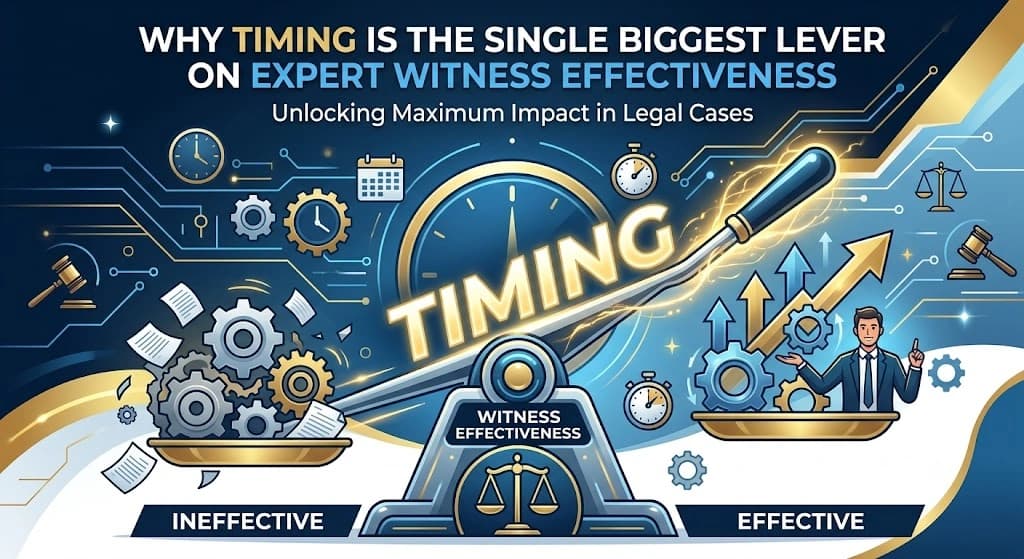
Ask a room full of litigators what separates persuasive expert evidence from evidence that gets quietly discounted, and you'll hear about credentials, clarity, and methodological rigor. Ask the same room when the expert should have been brought onto the case, and the answers get vague fast: "when it makes sense," "depends on the case," "as soon as reasonably practicable." That vagueness is the tell. Timing is treated as a scheduling detail in a process where it is, in fact, the single variable with the most leverage over cost, strategy, and how much weight a tribunal or court ultimately gives the opinion.
This is not a minor point buried in case management logistics. It is the difference between an expert who shapes the case theory and an expert who is handed a theory already built around gaps nobody flagged. It is the difference between a report grounded in a complete evidentiary record and one assembled under deadline pressure against facts that were never tested for their technical implications. And it is very often the difference between a fee that looks proportionate and one that looks, in hindsight, like the single largest line item nobody budgeted for.
The Three Windows: Pre-Dispute, Post-Filing, and Late-Stage
Every expert engagement falls, broadly, into one of three timing categories, and each produces a recognizably different kind of evidence.
Pre-dispute engagement means bringing in technical expertise before a claim crystallizes, often while a contract is still being negotiated, a project is still underway, or a dispute is a live possibility rather than a filed complaint. This is the least common model, largely because it requires treating expert input as a planning cost rather than a litigation cost. But it is also the model that produces the cleanest evidence, because the expert can observe events, methodologies, and decisions as they happen rather than reconstructing them from a paper trail assembled by people who did not anticipate a dispute. A technical advisor embedded before a project runs into trouble can flag the specific records worth preserving in real time, rather than trying to reconstruct their significance years later from whatever happened to survive.
Post-filing engagement is the default in most technical disputes. A claim has been filed or a request for arbitration submitted, the legal team has a working theory of the case, and an expert is brought in to test, support, or refine that theory. This is workable, most expert evidence that ends up before a tribunal or court was produced this way, but it comes with a built-in constraint: the expert inherits a case theory that was built without their input, and their job becomes retrofitting analysis to conclusions that may or may not survive technical scrutiny. In the better version of this model, the expert has enough runway to push back on the theory where the evidence does not support it. In the worse version, the timeline is already tight enough that pushing back feels like it threatens the whole case schedule, which quietly discourages the very scrutiny the engagement was supposed to provide.
Late-stage engagement is the model everyone in the profession recognizes and nobody defends: the expert is retained weeks, sometimes days, before a report deadline, often because an earlier expert dropped out, a settlement collapsed, or the scope of dispute expanded to cover ground the legal team did not originally anticipate needing expert input on. This is where timing stops being a strategic choice and becomes a crisis-management exercise, and the evidence produced under these conditions is recognizably different in quality from evidence produced with adequate lead time: thinner methodology sections, less time spent testing alternative interpretations, and a report structure that reads like it was built backward from a deadline rather than forward from first principles.
The point is not that pre-dispute engagement is always achievable or that post-filing engagement is a failure. It is that these three windows produce genuinely different products, and most case teams do not choose deliberately between them, they simply end up in whichever window their existing habits and budget pressures put them in.
What Gets Lost When Experts Arrive Late
The most intuitive cost of late engagement is compressed working time, and it is real: an expert given six weeks to analyze a complex causation or quantum question will produce a materially different report than one given six months, no matter how experienced they are. But compressed time is the least interesting cost, because it is the one everyone already understands and prices for, however imperfectly.
The less visible cost is what happens to the underlying factual record before the expert ever sees it. Facts get established, witness statements get drafted, and document review gets scoped, all without technical input on which facts actually matter to the analysis that will eventually need to be done. A quantum expert brought in after fact discovery closes may find that the specific operational data needed to model a loss scenario was never requested, because nobody thought to ask for it before the discovery window shut. A causation expert brought in after witness statements are locked may find that a lay witness described a technical process in a way that, innocently, forecloses the most defensible expert interpretation of what happened.
None of this is anyone's fault in the way it is usually described. It is not that counsel failed to think about expert evidence, it is that the sequencing of a typical case, facts first, theory second, expert evidence third, treats technical input as confirmatory rather than formative. By the time the expert is in the room, the record has already been shaped by people making judgment calls about materiality without the benefit of the one perspective built to make those calls well.
There is also a compounding cost that shows up specifically in multi-expert disputes, construction and engineering disputes being a common example, where a delay expert, a quantum expert, and a technical expert all depend on each other's inputs. If the delay analysis is not finished, the quantum expert cannot model the financial consequence of the delay; if the technical expert has not determined causation, neither of the other two has firm ground to stand on. Late instruction of any single expert in that chain does not just delay one report, it pushes the entire sequence backward, often forcing all three experts into compressed timelines simultaneously, at exactly the moment when careful sequencing matters most.
Timing as a Credibility Signal
There is a dimension to timing that gets discussed even less than cost: what it signals to a decision-maker about the independence of the opinion itself.
An expert instructed early, given time to review a complete record, and asked open questions about what the evidence shows reads differently, on the page and under questioning, than an expert instructed late and asked to validate a position the legal team has already committed to. This is not about honesty; most experts working under compressed timelines are still doing their genuine professional best. It is about the structural position the expert is put in. Late instruction, by its nature, narrows the range of questions an expert can meaningfully explore, because there is not time to explore alternatives before a deadline. A tribunal or judge who has seen enough expert evidence over time can often tell the difference between an opinion that emerged from open-ended analysis and one that emerged from confirming a predetermined conclusion under time pressure, not because either is dishonest, but because the second one tends to show less evidence of having seriously engaged alternative explanations.
This matters because persuasiveness in expert evidence is not primarily about credentials or presentation. It is about whether the decision-maker believes the expert actually tested their own conclusion before arriving at it. Timing directly affects how much testing was possible. An expert with four months can run three scenarios, discard two, and explain why. An expert with four weeks often has to commit to the first scenario that survives an initial pass, because there is not time for a second pass. Both experts might reach the same conclusion. But the report, and the witness under cross-examination, will look different, and decision-makers notice.
The Sunk-Cost Trap: Why Delay Persists Even When Everyone Knows Better
If the costs of late engagement are this well understood inside the profession, it is fair to ask why the pattern persists. Part of the answer is a version of the sunk-cost problem: early in a dispute, before a case theory feels urgent, expert input feels like a discretionary expense rather than a necessary one. Legal teams are, understandably, reluctant to ask a client to fund technical analysis before it is clear the case will proceed to a stage where that analysis is indispensable. That reluctance is rational at the level of a single decision. But it is the aggregate effect of many individually rational deferrals that produces the late-stage pattern across the profession as a whole.
The other part of the answer is structural rather than psychological. Procedural deadlines create forcing events, an expert report is due, a case management conference is scheduled, and forcing events are what actually trigger action in a busy litigation practice. Nothing about the value of early engagement creates an equivalent forcing event, so the decision to engage early has to be made deliberately, against the pull of every other deadline competing for the same attention. Left to its own devices, the system defaults to late engagement not because anyone believes it produces better evidence, but because nothing in the ordinary rhythm of a case forces the earlier decision to get made.
Recognizing this is useful precisely because it reframes the problem. It is not that practitioners need convincing that early engagement helps, most already believe that. It is that early engagement needs its own forcing event, built deliberately into case strategy, rather than being left to compete unsuccessfully against deadlines that already have institutional weight behind them.
Why "It Depends on the Case" Isn't a Strategy
The standard response to any push for earlier expert engagement is that timing depends on the case: its value, its complexity, whether liability is contested, how much budget the client has allocated. All of that is true, and none of it is an argument against having a deliberate timing strategy, it is an argument for building one that accounts for those variables rather than defaulting to instruction whenever the need becomes unavoidable.
Treating timing as something that "depends on the case" without a framework for how it depends on the case is functionally the same as having no timing strategy at all. It means the actual moment of engagement gets decided by whichever internal or external pressure is loudest at the time: a looming procedural deadline, a client asking why costs are rising, a co-counsel flagging that the current theory has a technical hole nobody can fill without expert input. None of those pressures are bad reasons to finally instruct an expert. But none of them are strategic either; they are reactive, and reactive timing produces the late-stage engagement pattern described above by default, not by design.
A more useful framing treats timing as a genuine decision point with real trade-offs to weigh deliberately: the cost of earlier engagement against the cost of a compressed, retrofitted analysis; the value of shaping fact discovery around technical materiality against the administrative complexity of bringing in expertise before a case theory is fully formed; the risk of instructing too early, before the real disputed issues are clear, against the much more common risk of instructing too late, after the record has already hardened around assumptions nobody tested.
What This Means for Law Firms and Clients
For firms managing technical disputes, the practical implication is straightforward even if the execution requires discipline: build an explicit checkpoint into case strategy, early, where the question of whether expert input is needed to shape the record, or only to interpret it later, gets asked deliberately rather than left to default timing. That checkpoint works best when it is calendared alongside the other early case-management milestones, rather than treated as a separate conversation that has to compete for attention against deadlines that already have institutional urgency.
For in-house teams and claims handlers, the implication is a budgeting one as much as a strategic one. Pre-dispute or early expert involvement is often treated as an avoidable cost precisely because it is easy to defer, nothing forces the decision the way a filing deadline does. But deferred cost is rarely eliminated cost. It typically resurfaces later as a larger, more compressed, more expensive engagement, layered on top of whatever inefficiencies were baked into the record during the period when no technical expertise was involved in shaping it.
For experts themselves, the implication is about how engagements are scoped at the outset. An expert accepting an instruction has a genuine interest in understanding where in the case timeline they are being brought in, because that answer predicts, more than almost anything else in the initial conversation, how much of their analytical judgment they will actually get to exercise versus how much time will be spent working around constraints imposed by decisions made before they arrived. Asking that question plainly, at the intake stage, is not a sign of difficulty, it is a sign that the expert understands what actually drives the quality of the work they are being asked to produce.
A Practical Framework for Deciding When to Engage
Rather than treating timing as instinctive, case teams benefit from asking three questions early, ideally before a case theory has fully hardened.
First, does the dispute turn on a technical or quantum question where the underlying facts still need to be established, or is the factual record already substantially complete? If the record is still forming, that is the strongest signal that early expert input will shape discovery in ways that pay for themselves later.
Second, is this a single-expert case or a multi-expert, sequenced case, construction and infrastructure disputes being the clearest example, where one expert's output is another's input? If so, the timing of the first expert in the chain deserves scrutiny well beyond what that expert's own workload would suggest, because delay there cascades.
Third, what does the client's risk tolerance for cost-versus-certainty actually look like? Early engagement costs more upfront and less in aggregate; late engagement costs less upfront and more in aggregate, with the added risk of a compressed, less-tested opinion. Clients rarely get asked to make this trade-off explicitly, it usually gets made for them, by default, through the ordinary rhythm of case management deadlines.
None of these questions guarantee a perfect answer. But asking them deliberately, rather than defaulting to whichever timing the procedural calendar happens to produce, is the difference between a timing decision and a timing accident.
Frequently Asked Questions
Is early expert engagement always more expensive? Not in aggregate. It typically costs more upfront but avoids the compressed, retrofitted work that drives up late-stage fees, so total cost across the life of the matter is often comparable or lower.
How early is "early enough"? There is no fixed rule, but the useful marker is whether fact discovery and witness evidence are still being shaped. If an expert can still influence what documents get requested or what a witness statement addresses, engagement is early enough to matter.
Does early engagement risk compromising the expert's independence? Not inherently, independence is a function of how an expert is instructed and treated throughout the engagement, not simply when they were retained. Early engagement can, in fact, strengthen independence by giving the expert time to test more than one interpretation before committing to an opinion.
What is the single biggest sign that an expert has been brought in too late? When the first substantive conversation with counsel involves working around constraints in the existing record, data that was not requested, testimony that forecloses a technical explanation, rather than shaping what the record should contain.
Should smaller-value disputes bother with early engagement at all? Proportionality matters, and not every dispute justifies pre-dispute involvement. But the underlying principle scales down: even in a modest case, a brief early conversation with a prospective expert about what evidence will matter costs little and can prevent the same record-hardening problem on a smaller scale.
Conclusion
None of this requires abandoning the reality that some cases genuinely cannot support early expert involvement, whether for budget reasons, case value, or the simple fact that a dispute was not foreseeable until it arrived. But most technical disputes have more room for deliberate timing than the standard practice of instruction suggests, and the gap between what is possible and what is typical is exactly where cost, credibility, and outcome quality are being left on the table. Timing is one of the few variables in expert evidence that a case team can actually control from the outset. Treating it that way, as a decision rather than a byproduct, is the single highest-leverage change available to any team serious about getting the most out of expert evidence. The teams that build a deliberate timing checkpoint into their process now will spend less time, later, explaining to a client why the expert budget grew so much larger than anyone expected.
Key Takeaways
● The window in which an expert is engaged predicts, more reliably than the expert's credentials, how useful and how expensive that engagement will be.
● Three broad engagement models exist, pre-dispute, post-filing, and late-stage, and each carries a distinct cost and credibility profile.
● Late engagement compounds: it does not simply delay the expert's work, it degrades the quality of the underlying factual record the expert has to work with.
● Timing is a decision counsel and clients can actually control, unlike many of the variables that get blamed for a weak expert case.
Position yourself where the legal industry looks for expertise - sign up on exlitem.com to get discovered by leading lawyers and high-value clients.